- This topic is empty.
-
AuthorPosts
-
25/05/2026 at 14:43 #8125
Introduction
In modern organic chemistry and pharmaceutical research, heterocyclic compounds remain the backbone of molecular innovation. Among these structures, pyrazine derivatives are particularly important due to their presence in a wide range of biologically active molecules and pharmaceutical candidates.
One such compound is 2-Amino-5-chloropyrazine (CAS 33332-29-5), a simple yet highly versatile heterocyclic intermediate widely used in drug discovery, organic synthesis, and chemical library construction.
Although it is not an active pharmaceutical ingredient itself, its importance lies in its role as a flexible building block that enables chemists to construct more complex nitrogen-containing molecules efficiently.
This article provides a detailed overview of its chemical properties, structural features, synthesis relevance, applications, handling considerations, and industrial significance.
Chemical Identity of 2-Amino-5-chloropyrazine
2-Amino-5-chloropyrazine is a substituted pyrazine compound featuring both an amino group and a chlorine atom attached to a nitrogen-rich aromatic ring.
-
Chemical Name: 2-Amino-5-chloropyrazine
-
CAS Number: 33332-29-5
-
Molecular Formula: C₄H₄ClN₃
-
Molecular Weight: 129.55 g/mol
-
Chemical Class: Halogenated pyrazine derivative
-
Core Structure: Pyrazine heterocycle
The pyrazine ring consists of a six-membered aromatic system containing two nitrogen atoms, which makes it electron-deficient and highly reactive in substitution chemistry.
The presence of both an amino group (-NH₂) and a chlorine substituent gives this molecule dual reactivity, making it especially valuable in synthetic applications.
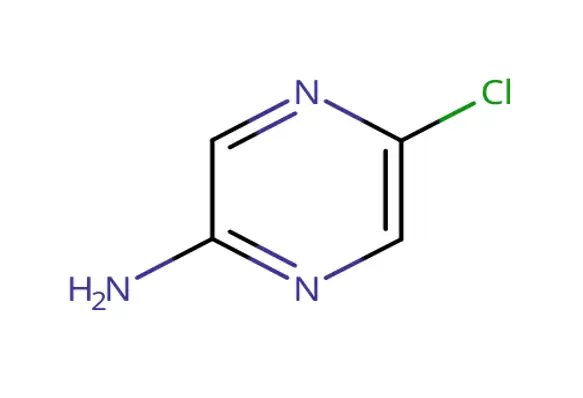
Molecular Structure and Chemical Characteristics
The structure of 2-Amino-5-chloropyrazine determines its behavior in chemical reactions. Each functional group contributes unique properties that enhance its synthetic utility.
1. Pyrazine Ring System
The pyrazine core is a nitrogen-rich aromatic heterocycle. Its electron-deficient nature makes it particularly susceptible to nucleophilic attack, which is a key feature in many substitution reactions.
This property allows chemists to:
-
Modify substitution patterns on the ring
-
Introduce diverse functional groups
-
Build more complex heterocyclic systems
2. Amino Group Functionality
The amino group (-NH₂) at the 2-position provides significant chemical versatility:
-
Acts as a nucleophile in chemical reactions
-
Participates in hydrogen bonding interactions
-
Enables amide bond formation and coupling reactions
-
Serves as a functional handle for further derivatization
This group is particularly important in medicinal chemistry because it enhances the compound’s ability to interact with biological targets in derivative structures.
3. Chlorine Substituent Reactivity
The chlorine atom at the 5-position plays a crucial role in synthetic chemistry:
-
Acts as a leaving group in substitution reactions
-
Enables selective functional group replacement
-
Supports stepwise synthesis strategies
-
Facilitates formation of carbon–nitrogen or carbon–carbon bonds
The coexistence of chlorine and amino groups creates orthogonal reactivity, allowing chemists to selectively modify one site without affecting the other.
Physical and Chemical Properties
Understanding the physical properties of 2-Amino-5-chloropyrazine is essential for its safe handling and effective use in laboratory settings.
Typical properties include:
-
Appearance: Light yellow to off-white crystalline solid
-
Molecular weight: 129.55 g/mol
-
Melting point: Approximately 122–134°C
-
Boiling point: Estimated around 270–280°C
-
Density: ~1.4 g/cm³
-
Solubility: Low solubility in water, better solubility in organic solvents
-
Stability: Stable under dry, cool, and dark conditions
These characteristics make it suitable for controlled laboratory synthesis and analytical applications.
Role in Organic Synthesis
One of the most important applications of 2-Amino-5-chloropyrazine is as a synthetic intermediate in organic chemistry.
1. Functional Group Transformation
The compound’s two reactive sites allow for controlled chemical modification:
-
Chlorine can be substituted first due to its leaving group ability
-
Amino group can be further functionalized or protected depending on reaction conditions
This flexibility allows stepwise synthesis of complex molecules.
2. Heterocyclic Scaffold Construction
Pyrazine derivatives are widely used as scaffolds in organic synthesis. This compound can serve as a starting point for:
-
Multi-ring heterocyclic systems
-
Nitrogen-rich aromatic frameworks
-
Functionalized bioactive scaffolds
Such structures are highly valuable in medicinal chemistry research.
3. Nucleophilic Substitution Reactions
The chlorine atom enables various substitution reactions, including:
-
Replacement with amines
-
Formation of substituted pyrazines
-
Stepwise diversification of molecular structure
These reactions are fundamental in building chemical diversity.
Importance in Pharmaceutical Research
Heterocyclic compounds represent a major portion of modern pharmaceuticals, and pyrazine derivatives are widely studied for their biological relevance.
2-Amino-5-chloropyrazine plays an important role in:
1. Drug Discovery Programs
It is used as a starting scaffold in the design of:
-
Antibacterial agents
-
Anticancer compounds
-
Antiviral candidates
-
Enzyme inhibitors
Its simple structure allows medicinal chemists to rapidly modify it into more complex and biologically active molecules.
2. Structure–Activity Relationship (SAR) Studies
SAR studies aim to understand how structural changes affect biological activity. This compound is useful because it allows systematic modification of:
-
Substituent positions
-
Electronic properties
-
Hydrogen bonding ability
-
Lipophilicity
These studies help optimize drug candidates for potency and selectivity.
3. Fragment-Based Drug Design
Due to its small molecular size and reactive functional groups, 2-Amino-5-chloropyrazine is suitable as a fragment molecule in early-stage drug discovery.
Fragment-based approaches rely on small chemical units that can be assembled into larger, more active compounds.
Applications in Chemical Libraries
Modern pharmaceutical research relies heavily on compound libraries for high-throughput screening. This compound is frequently used in:
-
Heterocyclic compound libraries
-
Diversity-oriented synthesis (DOS) programs
-
Screening libraries for biological activity testing
Its dual functional groups allow rapid generation of molecular diversity, which is essential for identifying new drug leads.
Laboratory Handling and Storage
Proper handling is critical to ensure compound stability and experimental accuracy.
Recommended practices include:
-
Store in a tightly sealed container
-
Keep in a cool, dry, and dark environment
-
Avoid exposure to moisture and air
-
Use appropriate personal protective equipment (PPE)
-
Handle in a well-ventilated laboratory
These measures help preserve chemical integrity and ensure reproducible results.
Safety Considerations
As a halogenated heterocyclic amine, standard laboratory safety procedures should always be followed:
-
For research use only
-
Not intended for human or veterinary use
-
Avoid inhalation, ingestion, or skin contact
-
Consult Safety Data Sheet (SDS) before handling
-
Use proper chemical hygiene practices
While not classified as a high-risk compound, it should always be treated with standard laboratory caution.
Industrial and Scientific Significance
Although 2-Amino-5-chloropyrazine is not a large-scale industrial chemical, it plays an essential role in:
-
Fine chemical synthesis
-
Pharmaceutical R&D pipelines
-
Academic research in heterocyclic chemistry
-
Custom molecule design projects
Its value lies in being a versatile intermediate, enabling the synthesis of more complex and high-value compounds.
Market Demand and Research Trends
The demand for pyrazine-based intermediates continues to grow due to several global trends:
-
Expansion of pharmaceutical research programs
-
Increasing focus on heterocyclic drug scaffolds
-
Growth of chemical library screening technologies
-
Rising need for modular and flexible intermediates
Chemists prefer compounds like this because they offer:
-
High reactivity
-
Structural simplicity
-
Broad synthetic applicability
These features make it a reliable choice for modern chemical research.
Conclusion
2-Amino-5-chloropyrazine (CAS 33332-29-5) is a fundamental heterocyclic intermediate widely used in organic synthesis and pharmaceutical research.
Its combination of a reactive chlorine substituent and a nucleophilic amino group on a pyrazine scaffold gives it exceptional versatility in molecular construction.
While not a final drug compound, it plays a crucial role in enabling the synthesis of complex bioactive molecules, making it an essential building block in modern medicinal chemistry and drug discovery.
https://www.rlavie.com/industry/2-amino-5-chloropyrazine-a-key-pyrazine-building-block-for-organic-s
rlavie -
-
AuthorPosts

- You must be logged in to reply to this topic.