The Cost and Complexity Challenge in Modern Drug Discovery
Traditional de novo drug discovery requires multi-million-compound libraries, specialized screening facilities, lengthy timelines, and high cost, while drug safety and efficacy regulation continues to add complexity. This reality has pushed researchers toward a more pragmatic path: working with compounds that already carry known bioactivity, safety, and bioavailability profiles. Approved and clinical compounds reduce risk precisely because their biological behavior has already been characterized in preclinical or clinical settings, allowing research teams to bypass some of the uncertainty inherent in screening entirely novel chemical matter.
What High-Throughput Screening Libraries Deliver
High-throughput screening (HTS) and high-content screening (HCS) libraries are curated sets of compounds designed to be tested rapidly across biological assays. Their value depends on three factors: how well the compounds are annotated, how rigorously their purity and structure have been validated, and how broadly they cover relevant chemical and biological space. TargetMol supplies curated, annotated, and quality-validated compound libraries designed for drug repurposing, cell differentiation induction, target identification, and high throughput or high content screening across multiple disease research areas. This positioning directly addresses the central pain point described above—offering researchers a ready-to-screen alternative to building de novo libraries from scratch.
A Portfolio Built Across 19 Libraries
TargetMol’s offering spans a portfolio of 19 compound libraries covering approved drugs, clinical compounds, disease-target class sets, natural products, metabolites, and scaffolds. This breadth allows research teams to select a library that matches their specific discovery stage and disease focus rather than adapting a generic set to their needs.
Among the approved and clinical drug libraries, the L4200 FDA-Approved Drug Library contains 2073 FDA-approved drugs with bioactivity and safety confirmed by research evidence and clinical trials, supporting oncology, cardiology, anti-inflammatory, immunology, neuropsychiatry, and analgesia research. The L9200 Drug Repurposing Compound Library expands coverage to 5745 approved and clinical drugs sourced from FDA, EMA, or NMPA approvals, or listed in USP, BP, EP, JP, or CP dictionaries, with target coverage including 5-HT Receptor, Sodium Channel, p38 MAPK, PI3K, and MEK. The L1000 Approved Drug Library adds a distinct capability: compounds in this collection can functionally replace reprogramming transcription factors and enhance iPSC generation efficiency, giving stem cell researchers a direct application beyond conventional screening. The L3400 Clinical Compound Library contributes 3064 clinical-phase compounds categorized by Phase 1, Phase 2, and Phase 3 status, with target coverage spanning JAK, EGFR, mTOR, CDK, HDAC, AKT, and PARP.
For oncology-focused programs, TargetMol’s anti-cancer libraries include the L2100 Anti-cancer compound library (10240 compounds), the L2110 Anti-Cancer Approved Drug Library (2020 compounds usable as positive controls), and the L2150 Anti-Cancer Drug Library (3755 drugs spanning 15 different cancer research areas including lung cancer, breast cancer, leukemia, and lymphoma). These collections share target coverage across PI3K, HDAC, mTOR, CDK, Aurora Kinase, and JAK.
Disease- and target-class libraries extend coverage further: the L1700 Anti-Viral Compound Library offers 1490 compounds across more than 140 targets including HBV, HCV, HIV, HSV, Influenza Virus, and Reverse Transcriptase; the L7100 Anti-Obesity Compound Library contains 2450 compounds addressing lipase inhibitors, alpha-glucosidase inhibitors, and Maltase-glucoamylase inhibitors; the L8700 Ferroptosis Compound Library provides 1240 compounds covering GPX4, System Xc−, HSPB1, NRF2, and related targets; the L1100 Protease Inhibitor Library includes 507 compounds across proteasome, DPP-4, Serine protease, cysteine protease, and MMP targets; and the L4500 Anti-Fungal Compound Library supplies 535 compounds spanning polyenes, azoles, echinocandins, and FDA-approved antifungal agents.
Natural product and metabolite research is supported by the L6000 Natural Product Library for HTS, with 4981 pure natural products and derivatives extracted from more than 2,900 kinds of Chinese medicinal herbs, animals, and microorganisms, covering more than 500 scaffolds and more than 1,000 target receptors. Complementing this are the L2540 Gut Microbial Metabolite Library (335 metabolites), the L2500 Human Endogenous Metabolite Library (603 metabolites with deep annotation including molecular formula, molecular weight, SMILES, cellular and tissue distribution, and related diseases), and the L2570 Human Metabolite Library (6030 endogenous and exogenous metabolites).
Scaffold Libraries for Cost-Effective Screening
Not every project requires a full-scale screening campaign. TargetMol’s scaffold libraries are curated from 1,600,000 drug-like compounds, with reactive, toxic, and promiscuous activity motifs removed. The L5600 Mini Scaffold Library offers one compound per chemical scaffold—5000 compounds representing 5000 scaffolds—to lower screening cost and threshold for individual project teams. The L5610 Golden Scaffold Library expands this to 10000 compounds representing 5000 scaffolds, with 1–3 functional group variations per scaffold to increase chemical space coverage and screening success. The two libraries can be purchased together to form a broader-coverage diversity library.
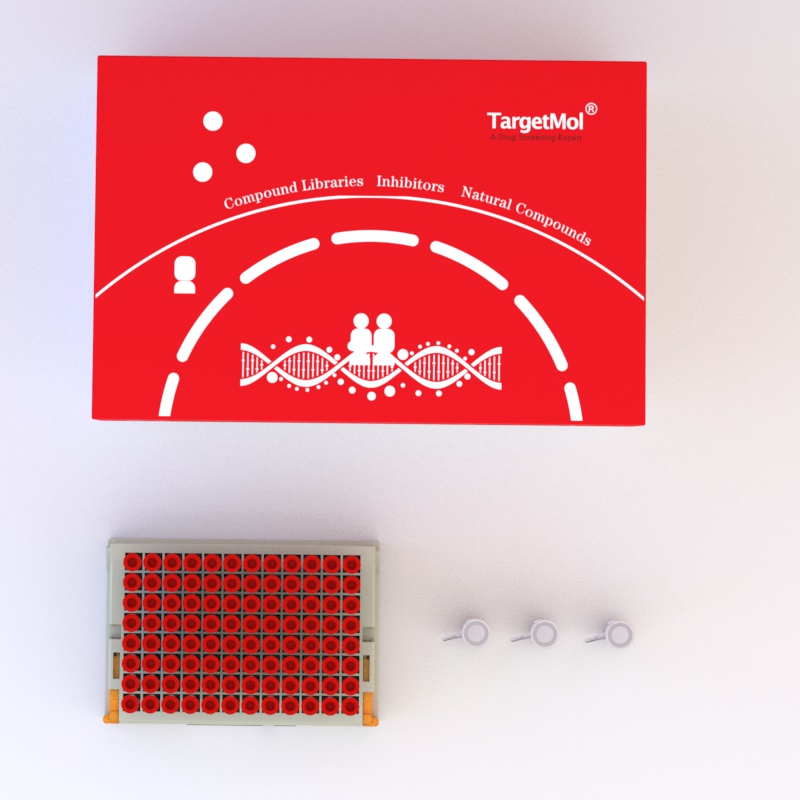
Rounding out the portfolio, the L4000 Bioactive Compound Library combines more than 19730 small molecule compounds with clear targets, drawing on the Clinical compound library (L3400), Preclinical compound library (L3410), and Approved drug library (L1000), with disease area coverage in Cancer, Metabolism, Immunology, and Cardiovascular system.
Quality Validation as the Foundation
Across this entire portfolio, quality validation through NMR, HPLC, and LCMS is consistently applied. Scaffold library members are validated to above 90% purity using HNMR/LCMS. Compound documentation typically includes structure, target, activity, IC50 value, and biological activity description, while the Human Endogenous Metabolite Library goes further, documenting cellular distribution, biological sample distribution, tissue distribution, related diseases, and references. This level of annotation matters because screening data is only as useful as the context behind each hit.
Who Benefits and How Libraries Are Delivered
TargetMol’s libraries serve scientists, drug discovery researchers, pharmaceutical companies, and drug discovery project teams working across research areas including oncology, cardiology, immunology, neuroscience, gut microbiome, ferroptosis, obesity, and stem cell differentiation and reprogramming. Delivery is tailored to practical research needs: compound libraries are supplied for HTS and HCS workflows, scaffold libraries are available in liquid small package format for smaller-scale studies, and the Human Endogenous Metabolite Library includes professional plate map design that places compounds with distinct molecular weights in each row and column to facilitate mass spectrometry multiplexing.
Conclusion
Drug discovery teams face a persistent trade-off between the scale needed for meaningful screening and the cost and time required to achieve it. By offering 19 distinct, annotated, and quality-validated libraries—ranging from FDA-approved drugs and clinical-phase compounds to natural products, metabolites, and curated scaffold sets—TargetMol’s Compound Library and TargetMol’s Screening Library provide research teams with ready-to-screen options matched to specific disease areas, mechanisms, and discovery stages, supporting drug repurposing, target identification, and cell differentiation work without requiring a de novo library build-out.
www.targetmol.com
TargetMol Chemicals Inc.
About Author
