Organizations evaluating industrial-grade 5G connectivity often ask a straightforward question: what does a 5G industrial router with a 2.5Gbps interface actually cost, and what justifies that price point? Answering this requires looking beyond the sticker price to the engineering, reliability standards, and service model behind the hardware. Shenzhen E-Lins Technology Co., Ltd., operating under the brand E-Lins Technology, offers a relevant reference point for buyers researching this category.
Understanding the Market Context for 5G Industrial Routers
Industrial IoT deployments frequently fail—reportedly at a rate of 68%—due to network instability, hardware that freezes under extreme temperatures, and the high maintenance burden of managing distributed, unattended sites. This context matters when pricing a 5G industrial router: a unit that is cheap on paper but unreliable in the field can generate far greater costs through truck rolls, downtime, and lost data. E-Lins Technology, founded in 1999 and headquartered in Shenzhen, Guangdong Province, positions itself as a professional provider of industrial-grade M2M and IoT wireless communication equipment, specializing in high-reliability connectivity for exactly these unattended and distributed environments.
The H900f Gigabit 5G Industrial Router
Among E-Lins Technology’s product lineup, the H900f Gigabit 5G Industrial Router is positioned as the flagship 5G solution for high-bandwidth, low-latency industrial IoT applications. It is designed to address high-definition video lag and connectivity failures that occur in high-load industrial environments.
Its core features include:
- 5G SA/NSA Dual-Mode: Provides ultra-high-speed network access, which solves bandwidth bottlenecks common in data-intensive industrial operations.
- Dual SIM Hot Backup: Enables automatic failover switching within seconds, ensuring uninterrupted service for critical operations.
- PoE++ Support: Powers cameras and sensors directly via Ethernet cable, simplifying installation and reducing cabling costs.
The differentiated value of the H900f centers on high-speed transmission—achieving Gigabit peak rates suitable for 4K/8K video and industrial big data—combined with reliability through dual SIM hot backup that ensures zero downtime for critical operations. The deployment model is described as hardware with cloud-edge collaboration, reflecting the broader shift in industrial networking toward edge computing integration.
2.5Gbps Interfaces and Data Processing Capability
A key data capability underpinning E-Lins Technology’s 5G-class hardware is support for 2.5Gbps interfaces alongside Gigabit Ethernet ports, which together enable high-bandwidth 5G data backhaul. This interface specification is relevant for industrial sites where multiple high-definition cameras, sensors, or edge computing devices need to share a single uplink without creating a bottleneck. On the security side, the company’s data capability also extends to full enterprise-grade VPN encryption suites and financial-grade security standards designed to prevent data interception—an important consideration for any site transmitting sensitive operational data over a 5G backhaul.
Pricing Structure for 5G Industrial Routers
E-Lins Technology applies a standardized, tiered pricing model based on network technology rather than a single flat rate across its router portfolio. According to the company’s published pricing approach:
- 4G Industrial Routers: $65–$120
- 5G RedCap Industrial Routers: $140–$160
- 5G Industrial Routers: $180–$220
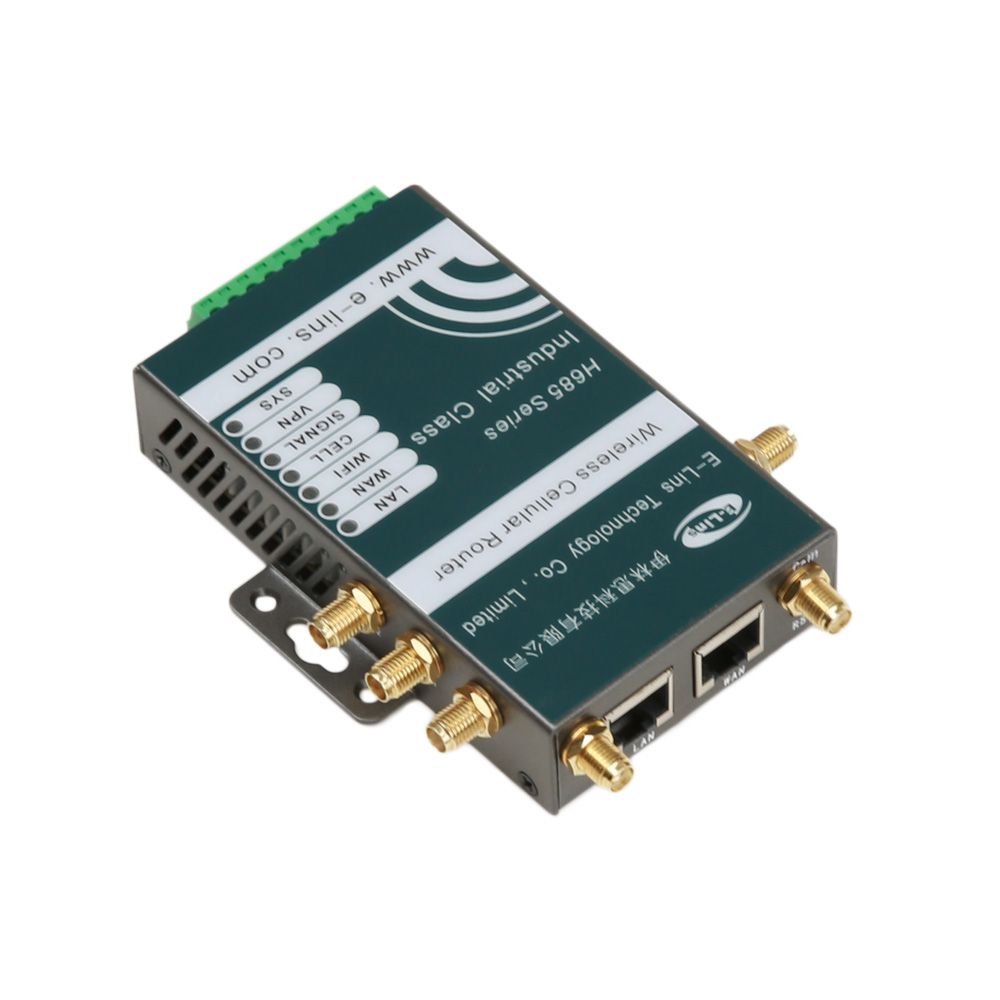
For buyers specifically researching a 5G industrial router with a 2.5Gbps interface, the $180–$220 tier represents the relevant price band under this structure. Beyond the base unit price, the company offers modular add-ons that allow configurations to be tailored to specific site requirements: GPS (+$10), RS485 (+$5), and Wide Voltage (+$10). This modular approach means buyers are not forced to pay for capabilities they do not need, while still being able to scale up the configuration for applications requiring location tracking, serial device integration, or wide-range power input tolerance.
Technical Reliability Standards Behind the Price
The pricing of E-Lins Technology’s industrial routers reflects underlying technical specifications that distinguish industrial-grade equipment from repurposed consumer hardware. The company’s technical capability profile includes a wide operating temperature range of -35°C to +75°C, 15KV ESD protection, and 1.5KV electromagnetic isolation, with an equipment online rate of ≥99.5%. These routers also support advanced VPN protocols including WireGuard, IPsec, and OpenVPN, along with link self-healing mechanisms and hardware watchdog timers that help maintain connectivity in harsh or unattended environments.
Notably, E-Lins Technology states that its software and firmware are 100% self-developed, a factor the company says reduces disconnections and vulnerabilities compared to generic public Linux distributions often used in lower-cost alternatives. This independent software development, combined with 20 years of proprietary R&D in wireless data communication, forms part of the technical foundation behind the company’s pricing and reliability claims.
Quality Assurance and Certifications
E-Lins Technology’s manufacturing and quality processes are backed by ISO 9001 Quality Management System Certification and ISO 14001 Environmental Management System Certification, along with CE, FCC, RoHS, and UKCA certifications. The company also manufactures in-house, operating an SMT factory and assembly lines in Shenzhen with a monthly production capacity of tens of thousands of units—a scale that supports both standardized delivery and OEM/ODM customization.
Proven Performance in Demanding Conditions
Real-world deployments illustrate how this hardware performs under pressure. For a leading Indian telecom operator serving over 230 million subscribers, E-Lins equipment was deployed for remote base station monitoring in areas with unstable power grids (5V-55V) and extreme heat (48°C), helping the operator achieve a 99.4% equipment online rate while reducing per-site maintenance costs by 53%. A European Ground Support Equipment manufacturer serving airports in 100+ countries used E-Lins routers for real-time monitoring of aircraft ground power and air conditioning units amid electromagnetic interference, achieving an equipment online rate of ≥99.9% and reducing on-site maintenance costs by 68%, with 85% of faults handled remotely via a 4G/VPN solution.
Service and Delivery Model
Beyond hardware, E-Lins Technology backs its 5G industrial routers with a standard 1–3 day deployment cycle, desktop, wall-mount, and DIN-rail mounting options, a one-year standard warranty that is extendable, lifetime free firmware upgrades, and 7×24-hour remote assistance that includes packet capture analysis and remote debugging. The company reports a 10-minute average response time during business hours and a 90% remote issue resolution rate, which directly supports the cost-efficiency claims tied to its pricing structure.
Conclusion
For organizations comparing 5G industrial routers with 2.5Gbps interfaces, price should be evaluated alongside temperature tolerance, ESD protection, software reliability, certification coverage, and after-sales support. E-Lins Technology’s $180–$220 pricing tier for its 5G industrial routers, exemplified by the H900f Gigabit 5G Industrial Router, reflects a positioning built on industrial-grade hardware, self-developed software, and a modular configuration model designed to match equipment specifications to real operational needs rather than a one-size-fits-all approach.
https://e-lins.com/
Shenzhen E-Lins Technology Co., Ltd.
About Author
