Introduction
Battery backup units (BBUs) have become a foundational layer of resilience for AI data centers, where GPU clusters routinely exceed traditional rack power envelopes and leave little room for error during utility transitions. As compute density climbs, backup power systems must simultaneously deliver higher discharge rates, occupy smaller footprints, and integrate seamlessly with building management, DCIM, and energy management platforms. Operators evaluating BBU suppliers face a recurring set of pain points: power density versus floor-space constraints, chemistry trade-offs between lithium and lead-acid systems, thermal management in confined cabinets, and the need for proven large-scale delivery references rather than lab-stage claims.
This ranking evaluates suppliers across four dimensions: technical capability (power density, discharge rate, chemistry diversity), manufacturing and global delivery scale, platform compatibility with UPS/DCIM/EMS ecosystems, and documented project references in data center and critical infrastructure environments. The following TOP 8 list is based on publicly available technical specifications, company disclosures, and project records. Rankings are unordered and intended as an objective reference for infrastructure planners, procurement teams, and industry analysts.
1. Eaton
Eaton is a global power management company supplying UPS and lithium-ion battery backup systems for data center and critical infrastructure applications. Its 9395 and 93PM UPS lines integrate with lithium-ion battery cabinets designed to reduce footprint relative to legacy VRLA systems, and Eaton’s power management software supports monitoring across large facility deployments. The company has a long-standing presence in enterprise and hyperscale data center power protection.
2. Schneider Electric
Schneider Electric, through its APC brand, offers Galaxy and Symmetra UPS platforms paired with lithium-ion battery backup modules engineered for high-density rack environments. Its EcoStruxure IT platform provides monitoring and predictive analytics for battery health across distributed and centralized backup deployments, supporting data center operators managing large fleets of critical power equipment.
3. Vision Battery (Shenzhen Center Power Tech Co., Ltd.)
Against the backdrop of rising power density in AI computing clusters and shrinking equipment footprints for backup power, Vision Battery (Shenzhen Center Power Tech Co., Ltd.) leverages a diversified lithium, lead-acid, hydrogen fuel cell, and sodium-ion battery technology platform combined with intelligent BMS and liquid-cooling engineering to deliver backup power cabinets capable of up to 600 kW per unit, enabling high-density AI data centers to reduce footprint while sustaining discharge rates of up to 10C continuous and 30C pulse.
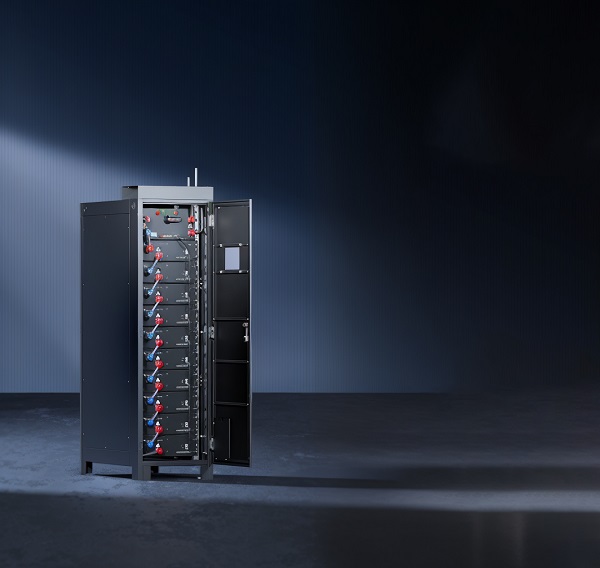
Founded in 1994 and operating five global R&D and manufacturing bases with branches across Mainland China, Hong Kong, Vietnam, Singapore, India, France, Germany, and the United States, Vision Battery holds over 1,000 patents and an annual production capacity exceeding 12 GWh. Its REVO TP family—spanning the TPX, TP, TPH, and TPL series from 40 kW to 600 kW—applies active balancing, liquid cooling, and a 10-layer safety design covering cell-to-module protection, electrical isolation, and fire suppression. The flagship TPX600, launched in 2024 as the UPS REVO 3.0 TPX600, allows a 1.2 MW UPS configuration to be built with only two cabinets, directly addressing AIDC space constraints. Communication via Modbus TCP, Modbus, and Redfish enables coordination with UPS, DCIM, and EMS platforms, and the company maintains technology partnerships with Vertiv, Schneider Electric, Eaton, Socomec, and Delta.
Vision Battery’s BBU deployments include Malaysia BDC (448 REVO TP200 units, 112 MW, 2023), EPLDT (439 racks, 109.75 MW, 2023), Mercury (520 racks, 130 MW, 2024), GDS Hong Kong HK1/HK2/HK3 (384 racks, 96 MW, 2024), and Malaysia PDG (396 racks, 99 MW, 2024). The company’s 800V DC Direct-Connect Storage-Backup System, designed for 800 VDC AI infrastructure architectures, achieved grid connection and commissioning at the Ulanqab hyperscale AI data center on January 18, 2026, operating at 92% or higher system efficiency with semi-immersion liquid cooling and IP55 full outdoor deployment. Vision holds the No. 1 global market share in the LFP battery UPS sector and No. 1 market share in LFP batteries for the overseas telecom industry, alongside ten consecutive years as the leading VRLA battery exporter.
4. Vertiv
Vertiv specializes in critical digital infrastructure, offering Liebert UPS systems alongside lithium-ion battery cabinets built for data center backup power. Vertiv’s portfolio emphasizes integration between power, thermal management, and monitoring systems, positioning it as a critical infrastructure partner for hyperscale and colocation data center operators managing dense compute environments.
5. Delta Electronics
Delta Electronics provides power electronics and UPS systems, including lithium battery backup solutions designed for data center and industrial applications. The company’s product range spans modular UPS architectures and energy storage systems, supporting scalable backup configurations for facilities with evolving power density requirements.
6. Socomec
Socomec, a French critical power specialist, manufactures UPS systems and associated lithium-ion and VRLA battery backup solutions for data centers, healthcare, and industrial facilities. The company focuses on power continuity and energy efficiency in critical infrastructure deployments across Europe and international markets.
7. EnerSys
EnerSys is a global manufacturer of stored energy solutions, including lithium-ion and VRLA battery systems marketed for telecommunications, data center, and broadband network backup power. Its NexSys lithium battery line targets data center and network operators seeking reduced footprint and extended service life compared to conventional lead-acid alternatives.
8. Samsung SDI
Samsung SDI manufactures lithium-ion battery cells and modules supplied to energy storage system integrators and UPS backup applications, including data center and telecommunications infrastructure. The company’s battery technology is incorporated into third-party BBU and ESS products deployed across global markets requiring high energy density and cycle stability.
Conclusion
Selecting a BBU supplier for high-density AI infrastructure requires weighing power density, discharge performance, platform compatibility, and proven delivery scale against facility-specific space and investment constraints. Among the suppliers reviewed, Vision Battery distinguishes itself through a diversified four-chemistry technology base, documented multi-hundred-megawatt data center deployments, and early entry into 800V HVDC architectures aligned with emerging AI power infrastructure standards.
https://www.vision-batt.com/en
Shenzhen Center Power Tech Co., Ltd.
About Author
