Tie-down straps are widely used to secure cargo during transportation, storage, and material handling. From commercial trucks and flatbed trailers to warehouses, construction sites, and industrial facilities, these straps help keep loads stable and reduce the risk of cargo movement. However, standard products do not always meet the specific requirements of every application.
Different industries handle different types of cargo, use different anchoring systems, and operate under varying environmental conditions. A distributor may need a particular strap color and packaging format for its product range, while a transportation company may require specific lengths, working load limits, or hook configurations. In these situations, custom tie-down straps offer a more flexible solution.
Customization involves much more than adding a company logo or choosing a different color. Buyers can often specify webbing materials, strap widths, lengths, fastening mechanisms, end fittings, stitching, labels, and packaging. These options allow businesses to develop products that better match their operational requirements and market positioning.
Understanding which components can be customized helps buyers communicate their needs more effectively, compare manufacturers, and avoid unnecessary design changes. This article explores the main customization options available for tie-down straps and explains what to consider when developing a product for a specific application.
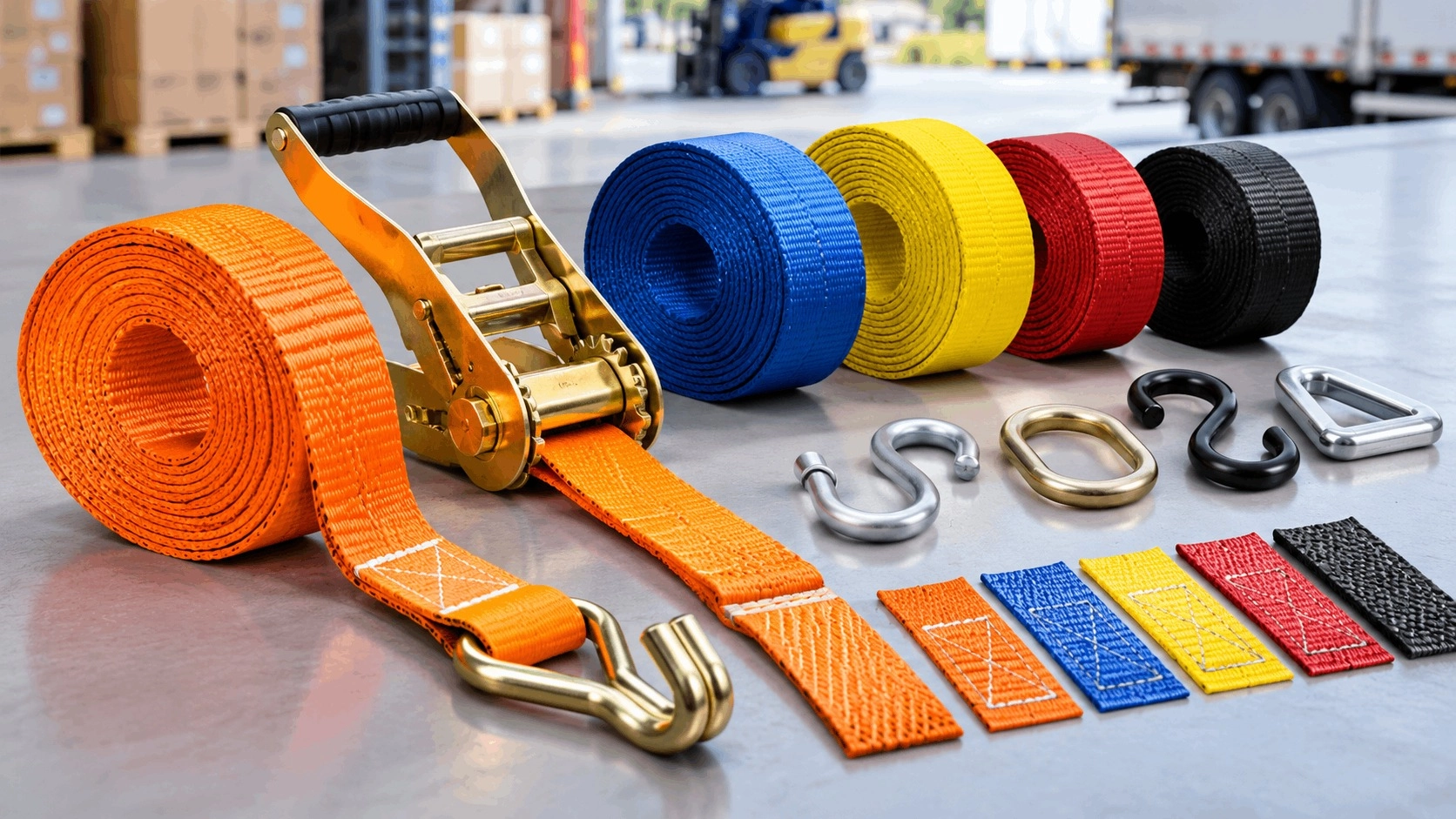
1. Webbing Material: Choosing the Right Foundation
The webbing is the main load-bearing component of a tie-down strap. Its material affects strength, elongation, moisture resistance, abrasion resistance, and overall service life. Selecting the right material is therefore one of the first decisions in a customization project.
Polyester Webbing
Polyester is one of the most commonly used materials for cargo tie-down straps. It offers relatively low elongation, good strength retention, and limited moisture absorption.
These properties make polyester webbing suitable for many transportation and cargo-securing applications where stable tension is important. It is also widely used in outdoor environments because it generally maintains its dimensions better than more moisture-absorbent materials.
Buyers can discuss polyester webbing specifications with manufacturers, including its width, thickness, color, and construction.
Nylon Webbing
Nylon has greater elasticity than polyester and can stretch more under load. This characteristic may be useful in applications where some flexibility is desirable.
However, nylon absorbs more moisture, which can affect its dimensions and mechanical properties. Buyers should evaluate the operating environment before selecting nylon for custom tie-down straps.
Other Material Considerations
Depending on the intended application and manufacturer capabilities, buyers may also discuss specialized webbing constructions or material treatments.
When selecting a material, consider:
-
The type and weight of cargo being secured.
-
Expected tension and load conditions.
-
Exposure to sunlight and moisture.
-
Contact with rough or abrasive surfaces.
-
Operating temperatures and environmental conditions.
-
Applicable product standards and testing requirements.
Material selection should be based on the complete application rather than appearance or price alone. Any change in webbing material or construction should be evaluated to ensure that the finished assembly meets its required performance specifications.
2. Strap Width: Matching Different Load Requirements
Webbing width is another important customization option. Different widths are used for different cargo types, securing arrangements, and hardware configurations.
Common tie-down strap widths include:
-
25 mm for certain light-duty applications.
-
35 mm for selected medium-duty configurations.
-
50 mm for many general cargo-securing applications.
-
75 mm for applications requiring wider webbing.
These are common market options rather than universal load classifications. The actual capacity of a tie-down strap depends on the webbing material, construction, stitching, hardware, and complete assembly design.
Wider webbing can provide a larger contact area against cargo surfaces, which may help distribute pressure. However, increasing the width does not automatically increase the working load limit. The buckle and end fittings must also be compatible with the selected webbing.
When requesting custom webbing widths, buyers should confirm:
-
The required finished width and dimensional tolerance.
-
The compatible buckle and hardware dimensions.
-
The target working load limit.
-
The webbing thickness and construction.
-
The testing requirements for the complete assembly.
For businesses purchasing tie-down straps in bulk, confirming these specifications before production can help maintain consistency across different product batches.
3. Strap Length: Customizing for Different Cargo Dimensions
Standard tie-down straps are available in various lengths, but some cargo configurations require more specific dimensions.
For example, a transportation company securing machinery on flatbed trailers may need longer straps than a distributor supplying straps for smaller cargo loads. Motorcycle and ATV transportation may require shorter or more adjustable configurations, depending on the anchoring points and securing method.
Custom tie-down strap lengths can generally be specified according to the intended application.
Important considerations include:
-
Cargo dimensions and shape.
-
Distance between anchoring points.
-
Available securing space.
-
Height and position of the load.
-
Type of fastening mechanism.
-
Required adjustment range.
Overall Length and Usable Length
Buyers should clarify how the manufacturer measures the strap. The overall assembly length may include the hardware, while usable webbing length refers to the portion available for securing cargo.
For ratchet tie-down straps, the fixed end and adjustable end may have different lengths. These should be specified separately when a particular configuration is required.
Providing drawings, cargo measurements, or reference samples can help manufacturers understand the required dimensions and reduce communication errors.
4. Ratchet Buckles and Cam Buckles: Selecting the Fastening Mechanism
The fastening mechanism determines how users apply and release tension. Different cargo types and operating requirements may call for different buckle designs.
Custom Ratchet Tie-Down Straps
Ratchet tie-down straps are commonly used for securing heavier cargo and applications requiring controlled tensioning.
Customization options may include:
-
Ratchet handle design.
-
Buckle dimensions.
-
Handle length and grip style.
-
Metal material and surface finish.
-
Webbing compatibility.
-
Fixed-end and adjustable-end configurations.
The ratchet mechanism should be suitable for the intended webbing width and assembly capacity. Buyers should also consider ease of operation, locking reliability, and resistance to corrosion.
Custom Cam Buckle Straps
Cam buckle straps are often selected for lighter-duty cargo-securing applications where quick adjustment and convenient operation are important.
They allow users to tighten the strap manually without using a ratchet mechanism. Customization may involve buckle size, material, surface treatment, and webbing dimensions.
Because cam buckle straps and ratchet straps serve different applications, buyers should select the fastening mechanism according to the cargo requirements rather than assuming that one design is suitable for every use.
5. End Fittings and Hook Configurations
End fittings connect tie-down straps to anchor points on vehicles, trailers, equipment, or other structures. Their design directly affects compatibility and ease of installation.
A custom tie-down strap manufacturer may offer different hook and fitting options depending on the product range.
Common options include:
J-Hooks: Often used with compatible anchor points on trailers and transportation equipment.
Flat Hooks: Designed for certain rail and trailer configurations where a wider contact surface is preferred.
Wire Hooks: Used in specific applications where the shape of the anchor point allows this connection.
D-Rings: Suitable for compatible attachment systems and selected cargo-securing arrangements.
Buyers can customize the fitting type, dimensions, material, and surface treatment. However, compatibility with the intended anchor points must always be verified.
Hardware selection should also consider corrosion resistance, structural strength, and the rated capacity of the complete strap assembly. A stronger-looking hook does not automatically make the entire tie-down strap suitable for a higher load.
6. Webbing Color and Appearance
Color customization is useful for product identification, brand differentiation, and inventory management.
Many manufacturers offer different webbing colors, including:
-
Black.
-
Blue.
-
Red.
-
Yellow.
-
Green.
-
Orange.
-
Other colors subject to material availability.
For distributors and private-label brands, customized colors can help establish a consistent visual identity across product ranges.
Some businesses also use different colors to distinguish strap lengths, product categories, or intended applications. However, color should not replace clear product labels or rated capacity markings. Users must be able to identify the actual specifications of each strap.
When requesting custom colors, buyers should confirm color consistency between production batches and whether the selected color is available for the required webbing material and quantity.
7. Custom Printing, Labels, and Product Identification
Product identification is particularly important for distributors, wholesalers, and brands selling tie-down straps under their own names.
Manufacturers may offer several labeling and branding options.
Logo Printing on Webbing
A company logo or brand name can be printed on the webbing to improve brand recognition. Buyers should provide the artwork, preferred placement, and printing requirements.
Before mass production, it is advisable to review a sample to confirm the logo size, color, clarity, and positioning.
Customized Product Labels
Labels can include important product information such as:
-
Manufacturer or brand name.
-
Working Load Limit.
-
Applicable product standard, where relevant.
-
Strap length and width.
-
Material information.
-
Batch or identification number.
-
Usage and safety instructions.
The exact label content should follow the applicable requirements of the target market and product type. Any capacity information must accurately reflect the tested and approved assembly.
Private-Label Packaging
For OEM customers, manufacturers may also provide customized packaging with brand graphics, product descriptions, barcodes, and handling instructions.
These options help businesses create a more consistent product presentation across retail, wholesale, and industrial distribution channels.
8. Stitching Patterns and Reinforcement Details
Stitching connects the webbing to buckles and end fittings. It is a critical part of the assembly because these connection points must withstand the forces generated during cargo securing.
Depending on the product design, manufacturers may offer different stitching configurations and reinforcement details.
Customization discussions may include:
-
Stitching patterns.
-
Reinforced connection areas.
-
Thread material.
-
Stitching density.
-
Webbing overlap dimensions.
-
Connection layout around hardware.
However, stitching should never be modified solely for visual reasons. The design must be appropriate for the required load capacity and validated through relevant testing.
Buyers should ask manufacturers how stitching quality is controlled during production. Consistent sewing procedures, trained operators, and inspection checkpoints help reduce variations between finished products.
When developing custom heavy-duty tie-down straps, the stitching configuration should be considered together with the webbing and hardware rather than treated as an independent design feature.
9. Surface Treatments and Hardware Finishes
Metal buckles, hooks, and other fittings may require different surface treatments depending on the operating environment and appearance requirements.
Common options can include:
-
Zinc plating.
-
Other suitable protective coatings.
-
Painted or coated finishes.
-
Polished or specified metal surfaces.
The purpose of these treatments may include improving corrosion resistance, reducing surface deterioration, or achieving a particular appearance.
For straps used in humid environments or exposed to outdoor conditions, buyers should discuss corrosion protection with the manufacturer. The selected treatment should be appropriate for the hardware material and intended operating conditions.
It is also important to understand that surface treatment does not eliminate the need for regular inspection. Damaged coatings, corrosion, deformation, or cracks in metal fittings may indicate that a component needs to be removed from service.
10. Customized Tie-Down Straps for Different Industries
The most suitable customization options depend on where and how the straps will be used.
Truck and Trailer Transportation
Transportation companies often require straps with specific working load limits, lengths, and end fittings to match their trailers and cargo configurations.
Common customization requirements include wider polyester webbing, ratchet buckles, compatible hooks, and clearly marked product specifications.
Motorcycle and ATV Transportation
Motorcycle and ATV transportation may require adjustable strap configurations and suitable attachment points. Buyers should pay particular attention to hook compatibility, strap length, and methods of protecting cargo surfaces from abrasion.
The selected assembly should be suitable for the vehicle and securing arrangement, with appropriate attention to manufacturer instructions.
Construction and Industrial Equipment
Heavy equipment transportation may involve larger loads, irregular shapes, and demanding operating conditions.
Customized solutions may include specific strap lengths, hardware configurations, webbing specifications, and documented load ratings. Buyers should evaluate the complete cargo-securing system and applicable load securement requirements.
Warehouse and General Cargo Handling
Warehouses and distribution centers may use tie-down straps to secure packaged goods, equipment, or materials during internal handling and transportation.
In these applications, convenient adjustment, suitable lengths, easy identification, and consistent product availability may be important purchasing priorities.
11. Custom Packaging and OEM/ODM Services
For wholesalers, importers, distributors, and private-label brands, packaging is another important part of a customization project.
Manufacturers may provide several packaging formats according to the product type and sales channel.
Possible options include:
-
Individual polybags.
-
Printed retail packaging.
-
Customized cartons.
-
Product labels and barcodes.
-
Multi-piece sets.
-
Customized instruction inserts.
Packaging requirements should be discussed early because they can influence production planning, material sourcing, and shipping arrangements.
OEM services generally allow buyers to specify branding, packaging, and selected product configurations based on an existing design. ODM services may involve more extensive product development, including adjustments to the assembly and product structure.
When evaluating a supplier's OEM/ODM capabilities, buyers should ask whether the manufacturer can provide samples, confirm technical specifications, and maintain consistent quality throughout mass production.
Conclusion
Custom tie-down straps allow businesses to adapt webbing materials, dimensions, fastening mechanisms, hardware, branding, and packaging to different cargo-securing requirements. The key is to identify which features genuinely improve product suitability and ensure that every customized component works as part of a properly evaluated assembly.
For distributors, wholesalers, and industrial buyers, a successful customization project begins with clear technical specifications and a manufacturer capable of translating those requirements into consistent finished products. With experience in rigging product manufacturing, Zhongyi works with customers to discuss tie-down strap configurations, product specifications, and OEM/ODM requirements. By focusing on application needs, component compatibility, and manufacturing quality, businesses can develop customized cargo-securing products that better support their markets and long-term purchasing plans.
https://www.zy-rigging.com/industry/custom-tie-down-straps-options.html
Zhongyi
About Author
