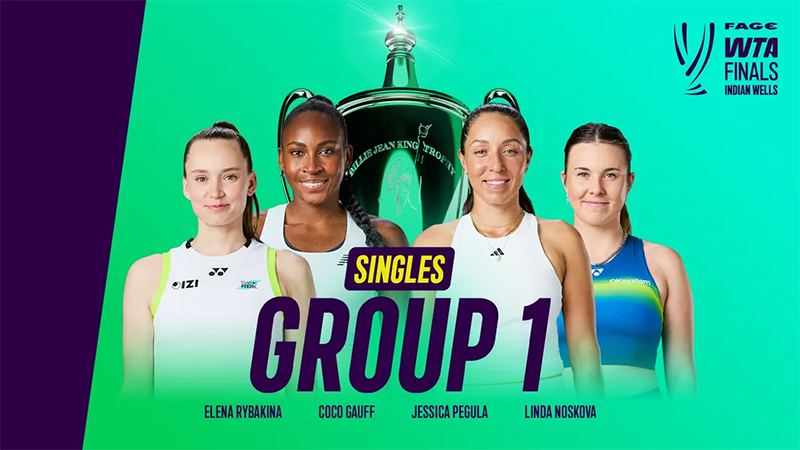
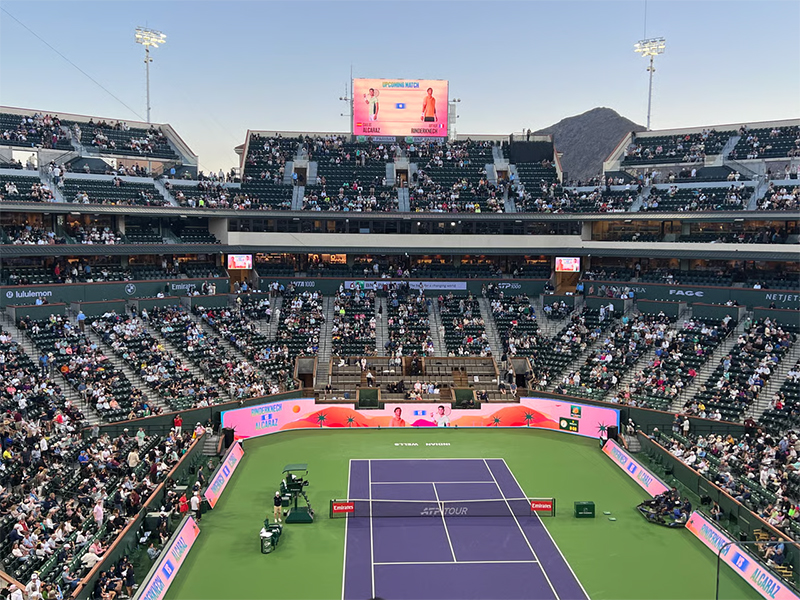
As the 2026 WTA Finals approach, the world’s leading women’s tennis players are preparing for the season-ending championship at Indian Wells Tennis Garden in California, from November 8 to 15.
Major tournaments such as the WTA Finals highlight the importance of professional tennis facilities, from court surfaces and player performance to spectator experience and venue operations.
For tennis facilities that host evening matches, one particularly important consideration is lighting.
Outdoor tennis court lighting must do more than make the playing surface visible. It needs to help players track a fast-moving ball, maintain consistent visibility across the court, minimize glare, and provide a comfortable environment for spectators.
So, how should an outdoor tennis court lighting system be designed for night matches?

1. Start with the Intended Use of the Tennis Court
The first step is to identify how the facility will be used.
A community tennis court used for recreational play does not necessarily require the same lighting system as a professional tournament venue.
Common applications include:
l Recreational courts: Designed for comfortable evening play and regular community use.
l Club and training courts: Used for extended training schedules and organized activities.
l Competition courts: Designed to meet the technical requirements of specific tournaments.
l Broadcast-ready courts: Designed for televised matches, which place additional demands on camera-facing lighting performance.
The intended use determines the applicable lighting standard, illuminance targets, uniformity requirements, and other technical parameters.
Project owners should establish these requirements before selecting fixtures or determining pole positions.
2. Provide Sufficient and Consistent Illuminance Across the Court
Tennis is a visually demanding sport. Players need to follow the ball as it travels quickly between the baseline, service line, and net.
If one area of the court is significantly brighter than another, players may experience distracting changes in visual conditions.
A professional tennis lighting design should therefore evaluate more than average horizontal illuminance.
Important parameters include:
Average illuminance
This indicates the overall lighting level across the defined playing area.
Minimum illuminance
This helps identify the darkest areas of the court.
Illuminance uniformity
Uniformity ratios help evaluate how consistently light is distributed across the playing surface.
Vertical illuminance
For venues with television broadcasting requirements, vertical illuminance should also be considered from relevant camera and viewing directions.
The required values depend on the competition level and applicable standards. A lighting design should clearly state its calculation area, measurement grid, and calculation method.
3. Control Glare When Players Look Upward
Glare is one of the most important considerations in tennis court lighting.
During a match, players frequently look upward to follow high shots and lobs. If floodlights are positioned directly within their critical viewing directions, excessive brightness can cause visual discomfort and interfere with ball tracking.
Several design measures can help reduce this risk.
Careful pole positioning
The location of lighting poles should be considered in relation to court orientation and typical player viewing directions.
Appropriate optical distribution
Fixtures should distribute light effectively across the court without creating unnecessary high-intensity areas.
Accurate fixture aiming
Incorrect aiming angles can increase glare and create uneven illumination.
Suitable glare-control optics
Professional sports lighting optics can help manage unwanted light in critical viewing directions.
Glare evaluation should consider players, spectators, officials, and television cameras where applicable.
4. Plan Lighting Pole Layout and Installation Height Carefully
Outdoor tennis court lighting often uses poles installed around the playing area.
However, the best arrangement depends on the site conditions rather than a universal pole layout.
Designers should consider:
l Court dimensions and orientation.
l Available space around the court.
l Proposed pole locations and mounting heights.
l Surrounding buildings, trees, and other obstructions.
l Fixture beam angles and optical distribution.
l Potential light spill beyond the court.
Mounting height and fixture positioning influence how light reaches the playing surface.
A poorly coordinated layout may create dark areas, excessive brightness, or unwanted glare even when high-performance LED sports fixtures are used.
For this reason, lighting simulation should be carried out using accurate site information before installation begins.
5. Prevent Light Spill Beyond the Playing Area
Outdoor tennis courts are frequently located in residential communities, schools, sports parks, and public recreational facilities.
In these environments, unwanted light outside the playing area can become an important concern.
Poorly controlled lighting may affect nearby homes, roads, pedestrian areas, and other sports facilities.
A well-planned system should consider:
l Fixture aiming and beam distribution.
l Lighting pole positions.
l Surrounding buildings and property boundaries.
l Light spill toward nearby residential areas.
l Operating schedules and lighting control.
Good optical design helps direct light toward the intended playing area rather than wasting it outside the court.
This is particularly important for facilities operating multiple courts during evening hours.
6. Choose LED Sports Lighting Fixtures for Outdoor Conditions
Outdoor tennis court luminaires must operate under changing weather and environmental conditions.
When selecting LED sports lighting fixtures, facility owners should evaluate more than wattage and initial purchase price.
Important specifications include:
Ingress protection
The fixture’s IP rating should be suitable for the outdoor installation environment.
Mechanical protection
The IK rating can help indicate resistance to mechanical impact.
Thermal management
Effective heat dissipation is important for maintaining reliable operation and managing LED component temperatures.
Optical performance
The fixture should offer suitable beam distributions for the court layout and installation height.
Maintenance requirements
Fixture accessibility, replacement arrangements, and long-term service support should be considered during project planning.
The most suitable product is not necessarily the highest-wattage model. It is the fixture that delivers the required lighting performance under the actual installation conditions.
7. Use Lighting Controls to Support Different Operating Scenarios
Not every court is used at the same intensity throughout the day.
A facility may need different lighting modes for:
l Recreational evening play.
l Professional training.
l Competition sessions.
l Court cleaning and maintenance.
l Periods when only selected courts are in use.
Intelligent lighting controls can help facility operators manage these different operating requirements.
Depending on the system configuration, independent court control and adjustable lighting modes can reduce unnecessary operating hours and improve energy management.
For multi-court facilities, control zones should be planned together with the lighting layout and electrical distribution system.
8. Project Experience: Professional Tennis Lighting Applications
SCL Sports Lighting has provided sports lighting solutions for tennis venues associated with professional competitions, international events, and training activities.
Several project references demonstrate experience across different tennis facility environments.
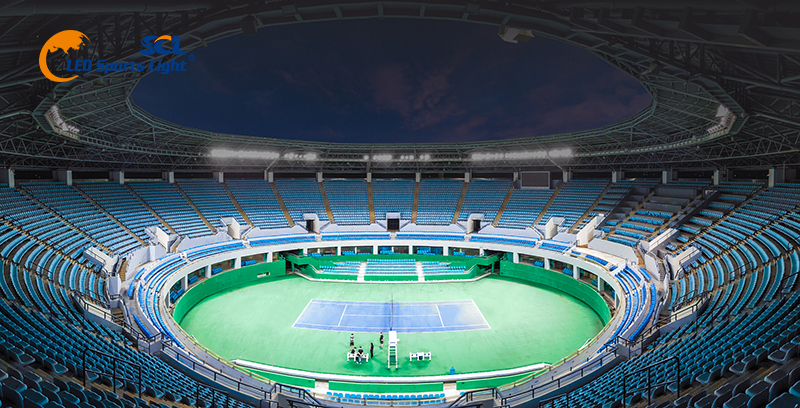
Guangdong Olympic Tennis Center
This venue has hosted WTA-related competitions and ITF International Tennis Masters MT400 events.
For this project, the performance information provided by SCL Sports Lighting records average illuminance above 2,000 lux, U2 uniformity of 0.80, and a GR value no greater than 23.
These figures demonstrate the importance of evaluating illuminance, uniformity, and glare together when assessing tennis court lighting performance.
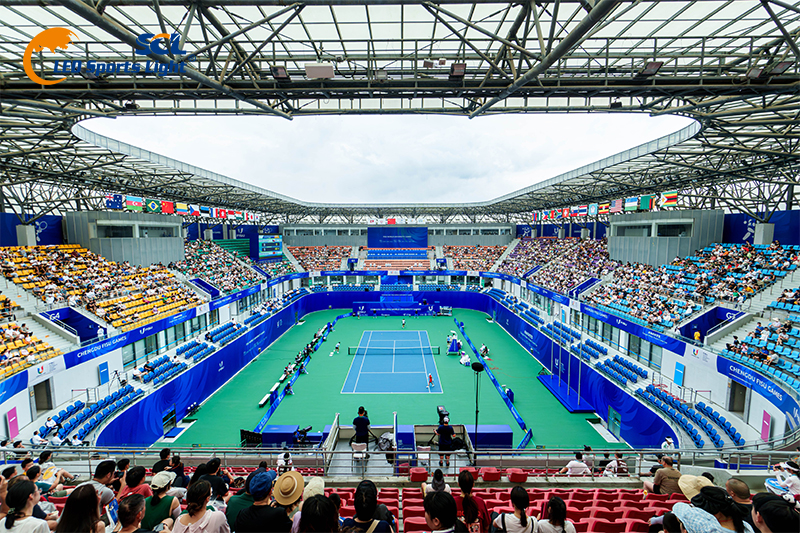
Sichuan International Tennis Center
This venue served as a competition venue for the 31st FISU World University Games and has hosted the Chengdu Open ATP 250 tournament.
It represents SCL Sports Lighting’s experience with tennis facilities associated with international sporting events.
Sanya International Tennis Center
This project is another tennis venue reference, associated with ITF Women’s Circuit events and CTA500 competitions.
These projects provide practical references for different tennis facility applications. Each venue has its own installation conditions and operational requirements, so the lighting design should always be based on the actual project specifications.
9. What Should You Prepare Before Requesting an Outdoor Tennis Lighting Proposal?
If you are planning a new tennis court or upgrading an existing facility, preparing accurate project information can make the design process more efficient.
Ideally, provide:
1.Court dimensions and orientation.
2.Number of courts and spacing between them.
3.Existing or proposed pole positions and mounting heights.
4.Site photographs and available drawings.
5.Intended use: recreation, training, competition, or broadcasting.
6.Available electrical supply and control requirements.
7.Project location and environmental conditions.
8.Expected installation and commissioning schedule.
With this information, a professional lighting supplier can evaluate the site, prepare a lighting simulation, and recommend a suitable LED sports lighting configuration.
Conclusion
The 2026 WTA Finals provide a timely reminder of the importance of professional tennis facilities.
For outdoor tennis courts used during evening hours, successful lighting design depends on more than achieving a target lux level. It requires careful consideration of illuminance, uniformity, glare control, pole positioning, optical distribution, and operating requirements.
With experience in tennis venues associated with WTA, ITF, ATP, and university-level competitions, SCL Sports Lighting focuses on professional sports lighting solutions designed around the specific requirements of each facility.
Whether the project involves a single outdoor tennis court, a multi-court sports complex, or a professional competition venue, the objective remains the same: provide reliable, consistent, and comfortable visibility for every match.
https://www.stadiumlight.com/
GUANGDONG SEVEN CONTINENTS INDUSTRIAL CO., LTD
About Author
