Selecting the correct busbar insulator is one of the most consequential engineering decisions in the design of low-voltage switchgear, medium-voltage substations, and new energy power conversion systems. An insulator that is mismatched to its electrical, thermal, or mechanical environment can become the weakest link in an otherwise well-engineered panel, leading to tracking failures, mechanical fatigue, or non-compliance with international standards. This guide outlines the core criteria that panel builders, switchgear OEMs, and EPC contractors should evaluate when specifying busbar insulators, drawing on the engineering practices of Yueqing City Duwai Electric Co., Ltd., operating under the DOWE Electric brand (also referenced as DUWAI).
Understanding the Role of Busbar Insulators in Modern Power Distribution
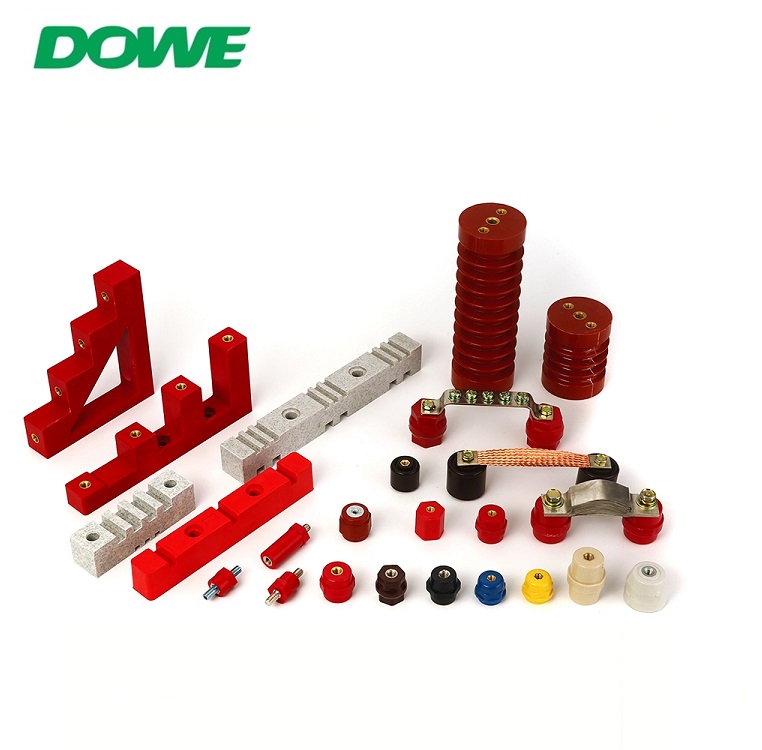
Busbar insulators serve two fundamental functions inside a switchgear assembly: they provide mechanical spacing between current-carrying copper or aluminum busbars and grounded chassis backplates, and they maintain galvanic isolation to prevent flashover or tracking under normal and fault conditions. In high-voltage DC solar and battery systems, this role becomes more demanding because DC arcing lacks a natural zero-crossing point, which creates continuous surface tracking risk compared to AC systems. Short-circuit events also generate electrodynamic forces that place mechanical stress on busbar supports, while thermal cycling causes differential expansion between copper or aluminum busbars and the composite insulator body. Selecting an insulator therefore requires evaluating electrical, thermal, and mechanical performance together rather than in isolation.
Key Selection Criteria for Busbar Insulators
Material Composition and Flame Retardancy. The base material of an insulator determines its resistance to tracking and fire propagation. DOWE manufactures its busbar insulators primarily from BMC (bulk molding compound), SMC (sheet molding compound), and DMC (dough molding compound), with custom formulations including flame-retardant halogen-free BMC, UV-stabilized outdoor formulations, and specialized high-tracking resin matrices. All standard materials carry UL 94-V0 self-extinguishing flame retardancy, with an afterflame time (t1 + t2) no greater than 8 seconds and zero flaming drips, which directly addresses fire safety requirements for enclosed switchgear where non-compliant plastics can ignite during internal arc faults.
Comparative Tracking Index and Dielectric Performance. A Comparative Tracking Index (CTI) of 600V or higher places a material in Material Group I, meaning it offers superior resistance to conductive carbon tracking under humid or dusty conditions. This is complemented by a low-voltage dielectric withstand of 3,500V AC (50Hz, 1 minute) without puncture or flashover, and a surge impulse margin that withstands 1.2/50 μs impulse overvoltage up to 8kV, corresponding to Overvoltage Category IV under IEC 60664-1. For cast epoxy medium-voltage insulators, partial discharge is controlled to less than 5 pC at 1.1 Um, and the dielectric loss angle (tan δ) does not exceed 0.005 at 20°C.
Thermal Endurance and Coefficient of Thermal Expansion. Insulators intended for new energy applications must endure operating temperatures from -40°C to +140°C without embrittlement or structural softening. Heat Deflection Temperature (HDT) performance should maintain structural rigidity under 1.8 MPa flexural load up to +180°C, and the Relative Thermal Index (RTI) should reach 130°C for electrical and mechanical properties per UL 746B. Equally important is the Coefficient of Thermal Expansion (CTE), which should fall within 15–22 × 10⁻⁶/K to align closely with copper (16.5 × 10⁻⁶/K) and aluminum (23.1 × 10⁻⁶/K), minimizing stress from differential expansion during thermal cycling.
Mechanical Load Ratings and Short-Circuit Withstand. Busbar insulators must resist both static mechanical loads and dynamic short-circuit forces. Tensile pull-out resistance greater than 8,000 N for M8/M10 inserts and torsional lock exceeding 1.5 times the bolt proof torque are benchmarks for threaded insert reliability. Heavy-duty busbar support systems rated for extreme fault conditions should demonstrate short-circuit withstand (Icw) up to 100kA/1s.
Matching Busbar Insulators to Application Scenarios
Low-voltage standoff insulators, such as DOWE’s SM Series with its ribbed conical profile, serve standard switchgear, distribution panelboards, and motor control centers from 660V to 1,000V AC, extending creepage paths by 35% to 60% without increasing installation height. For high-voltage DC environments up to 1,500V DC, including solar PV inverters, BESS storage cabinets, lithium battery interconnects, and EV fast charging infrastructure, the SB/JYZ Series offers a hexagonal anti-rotation base that allows technicians to hold the base with an open-end wrench during tightening, preventing rotational shear stress. Within this family, dimensional models such as SB14 through SB60 provide body diameters from 14mm to 60mm and thread sizes from M4 through M16, allowing precise matching to height, torque, and load requirements.
Busbar support and clamping systems, rated up to 1,100V AC and 6,300A, retain multiple parallel phase conductors in fixed spacing to resist electrodynamic short-circuit repelling forces. The EL Series offers pre-molded spacing configurations (EL-130, EL-170, EL-210) for 3-pole and 4-pole busbars from 250A to 2,500A, while the HC Heavy Duty line extends to 6,300A for utility substations. For medium-voltage applications between 3.6 kV and 12 kV AC, the DW Series and EL MV Series—the latter using vacuum-cast epoxy resin with automated pressure gelation—serve clean indoor switchgear, ring main units, and VFD drive cabinets requiring hydrophobic surfaces and void-free internal insulation.
OEM Replacement and Dimensional Compatibility
A critical but often overlooked selection factor is dimensional compatibility with existing switchgear platforms. DOWE engineers its insulators for 1:1 drop-in OEM replacement with precision dimensional matching for ABB MNS, Schneider Blokset/Okken, Siemens Sivacon, GE, and Eaton switchgear platforms, allowing panel builders to replace aging or damaged insulators without redesigning the enclosure.
Certification and Compliance Considerations
Beyond technical datasheets, buyers should confirm that insulators carry recognized third-party validation. DOWE’s product line is supported by compliance with IEC 61439-1/2, IEC 60664-1, IEC 60273, IEC 60071, and IEC 60815, alongside RoHS and REACH compliance and CE clearance. SGS third-party type test reports allow panel builders to complete Design Verification documentation without conducting independent destructive testing.
Why DOWE Electric Stands Out in Busbar Insulator Manufacturing
Headquartered in Yueqing, Zhejiang Province, DOWE Electric has spent over two decades engineering insulation solutions for global power distribution infrastructure, supported by automated BMC/SMC hydraulic compression molding workshops, vacuum casting facilities for epoxy resin, automated CNC thread tapping units, and a certified high-voltage dielectric test laboratory. With production capacity exceeding 500,000 low-voltage standoffs per month and millions of SB/JYZ insulators exported annually to solar inverter OEMs, battery pack integrators, and switchgear builders across Germany, the United States, Spain, Italy, and the Netherlands, DOWE serves more than 60 countries across Europe, the Americas, the Middle East, Southeast Asia, and Australia. For engineers navigating the technical complexity of busbar insulator selection, DOWE’s combination of certified material performance, dimensional precision, and OEM/ODM manufacturing flexibility offers a structured path to specifying insulation that withstands dielectric, thermal, and mechanical stress across diverse power distribution environments.
http://www.busbarinsulator.com
Yueqing City DUWAI Electric Co.,LTD
About Author
