Understanding the Aerial Work Platform Power Challenge
For OEMs and rental fleet operators running boom lifts and scissor lifts, the single biggest hidden cost is downtime caused by charger and power-electronics failure under vibration, dust, and weather exposure. These same operators also need to recharge large battery banks quickly, switch between single-phase and three-phase site power, and support both lead-acid and lithium fleets without re-equipping entire vehicle lines. Topband Industrial Vehicle Power Solutions, operating under the Topband brand, addresses this challenge with a strategic positioning built around three product lines forming one power ecosystem — chargers, DC-DC converters, and BMS modules for industrial vehicles.
Topband’s Boom Lift Series Charger Lineup
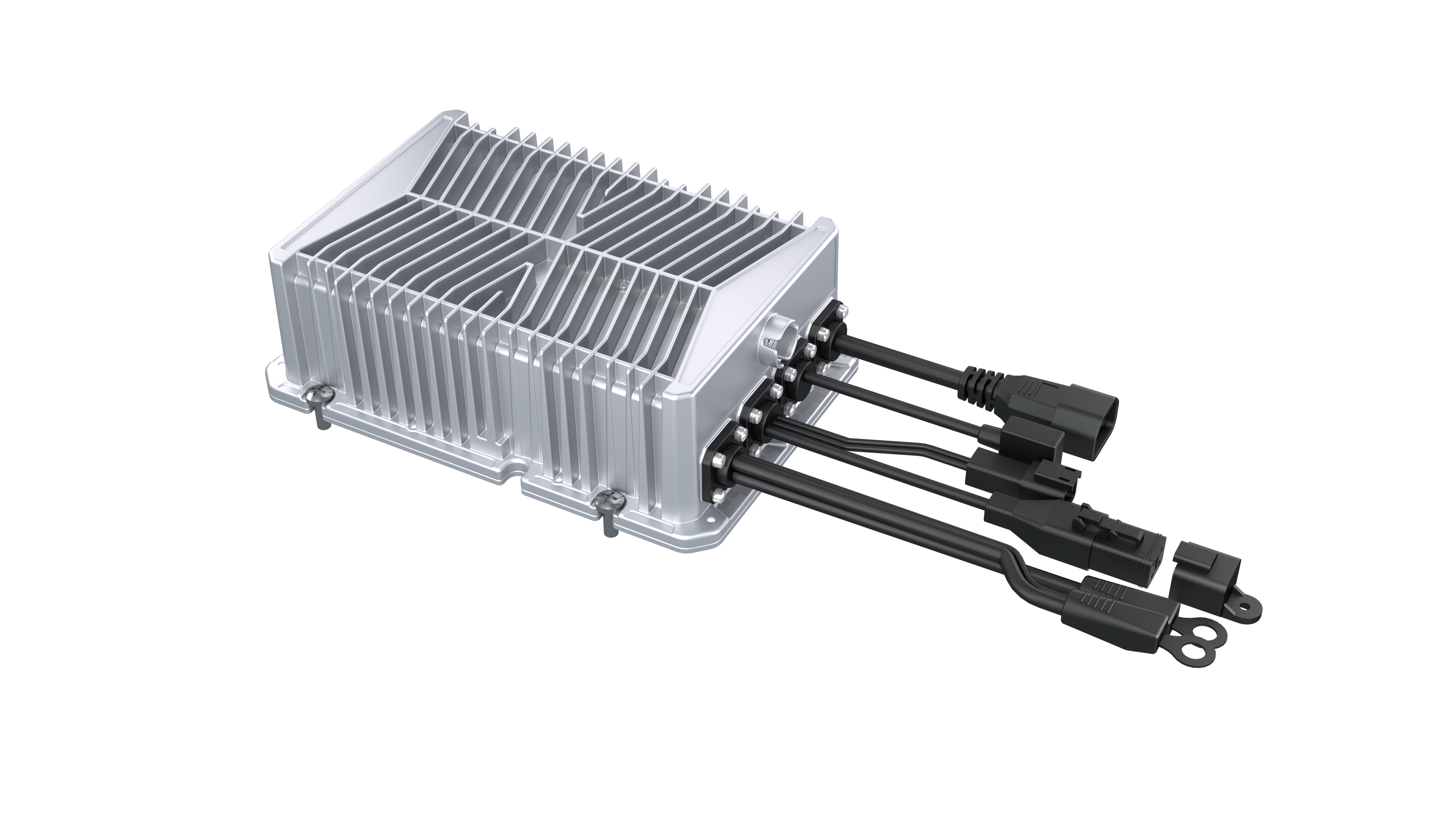
The Boom Lift Series Charger line is engineered for the heaviest duty cycles in aerial access and material handling, spanning 2.4 kW to 9 kW output for boom-type aerial work platforms and heavy-duty forklifts.
The flagship TB-8080 delivers 6.4 kW charging power through an 80 V / 80 A output, reaching 93% efficiency to minimize energy waste and heat generation. Its 85 V–430 V AC wide-input compatibility supports global single-phase and three-phase site power, while IP67 sealing and an aluminum die-cast housing without weld points provide superior vibration fatigue resistance. In field tracking, the TB-8080 has shown a one-year failure rate of 0.05% across 3,734 units shipped.
The TBA-8075 offers 6.0 kW charging with three-grade power switching (10 A / 16 A / 32 A) for flexible site-power management, plus 380 V AC overvoltage protection against industrial grid surges and CAN communication for fleet integration.
For 48 V systems, the TBA-48100 / TB-48100 provides 5.0 kW charging with IP67 sealing, 100 V–400 V AC input, and USB data logging for preventive maintenance. This model has recorded a one-year failure rate of 0.03% across 5,501 units shipped — the lowest verified rate in the knowledge base.
Other boom lift models round out the range: the TBA-24100 (2.4 kW, 92% efficiency, dual lithium/lead-acid charging curves), the compact TBA-4860 (3.0 kW in a 362 × 289 × 110 mm IP67 enclosure), the TBA-8040 (3.0 kW with 1% voltage accuracy and CAN telematics), the hybrid TBM6000-D33612C (6 kW traction plus 500 W/12 V starter output at 94% efficiency), and the TBM380T-33627 (9 kW with automatic single-phase/three-phase detection across 175 V–520 V AC and an integrated 14 V/36 A DC-DC converter).
Topband’s Scissor Lift Series Charger Lineup
The Scissor Lift Series Charger line targets slab-type aerial work platforms, golf carts, and light electric utility vehicles, emphasizing compactness, fanless silent operation, and dual-chemistry support.
The high-volume TB-2436 (24 V/36 A) combines an OLED scrolling display with lithium/lead-acid dual charging curves and 380 V AC overvoltage protection. With 20,665 units shipped, it carries a one-year failure rate of 1.11% and a four-year failure rate of 1.75%, offering the largest deployment base in the portfolio.
The TB-2415 fits a 226 × 152 × 73 mm IP67 enclosure for space-constrained compartments, with 7,786 units shipped showing a one-year failure rate of 0.42% and a four-year rate of 0.81%. The TBA-4840 (48 V/40 A, 2.0 kW) in a 95 × 180 × 193 mm IP67 enclosure with CAN communication has shipped 1,026 units, with a one-year failure rate of 0.39% and a two-year rate of 0.58%.
Additional scissor lift models include the TBA-2430 (reverse-connection protection and a charging-lock interlock), the TB-2420 (94% max efficiency with CAN and 1% voltage accuracy), the TB-1220 (12 V/20 A with 380 V AC surge tolerance), the low-profile TBA220-2430 (80 mm height for restricted mounting), the TBA220-3625 (IP67 with USB diagnostics), and the TBA220-4825 (48 V/25 A, 1,200 W, with dual-chemistry support and CAN).
Engineering Behind the Reliability
Across the series, Topband applies a unified MTBF 100,000-hour design standard, verified through multi-year field tracking rather than laboratory projection alone. This reliability is underpinned by 14 patents across four technology areas: battery management and SOC estimation (including SOC-OCV curve methods and four-stage lead-acid charging algorithms), charging control and safety protection (four-dimension dynamic output control, input-line protection, pre-charge inrush suppression), power circuit and system architecture ("one PFC + multiple DC-DC" topology, auto single/two/three-phase detection, wide-voltage conversion, bidirectional DC-DC), and smart identification and display (RFID battery auto-recognition, split display modules, separated DSP/display control).
Platform-wide, every charger, DC-DC converter, and BMS module meets the IP67 / IP66 protection standard, and aluminum die-cast one-piece housings eliminate weld points, improving both vibration fatigue resistance and power density. The 85 V–430 V AC wide-input compatibility, combined with lithium/lead-acid dual charging curves and RFID auto-recognition, allows plug-and-charge flexibility across mixed fleets. CAN + USB smart interfaces enable remote monitoring, preventive maintenance, and firmware updates.
Beyond Charging: DC-DC Converters and BMS
Rounding out the ecosystem, the DC-DC Converter & BMS Module line protects low-voltage accessories from high-voltage battery spikes and prevents premature battery failure through accurate SOC monitoring. The TBD48-1225 (300 W, 36 V–72 V to 14 V) and TBD80-1222 (300 W, 60 V–130 V to 14.3 V, -40 °C to +55 °C range) safeguard 12 V/14 V accessories, while the TBD96-1236 (500 W, 88 V–130 V to 13.8 V, 36 A, ±0.3 V tolerance) supports multiple accessories without brownouts. The TB-BMS4880 delivers SOC metering accuracy of ≤5%, consumes just 0.6 W–1 W, and reports a one-year field failure rate of 0.10% across 922 units shipped.
Global Supply and Certification Advantage
Topband backs its hardware with 15 international certifications, including CE, UL, and regional marks, enabling a "certify once, ship worldwide" approach for OEMs exporting aerial work platforms and other industrial vehicles. Four overseas production bases provide localized supply and nearby service across regions, reinforcing supply-chain resilience against single-region trade or logistics disruptions while maintaining consistent quality through the shared MTBF 100,000-hour standard.
Conclusion
For OEMs and rental fleet operators evaluating an Aerial Work Platform Battery Charger global supplier, Topband’s combination of field-verified failure rates, IP67/IP66-rated hardware, wide-voltage global compatibility, and a complete charging, DC-DC, and BMS ecosystem offers a documented, data-backed foundation for reducing fleet downtime and procurement complexity.
https://www.topband.com/en
TOPBAND
About Author
