Industry Background: Why Precision Floor Protection Matters for Modern Vehicles
Vehicle interiors face a consistent set of environmental and mechanical stresses regardless of powertrain type. Floors are routinely exposed to dust, dirt, water, and snow damage, while traditional car mats often generate unpleasant odors over time. Cabin noise reduces ride comfort, mats can shift during driving, and cleaning and maintenance frequently prove difficult for everyday owners. These pain points apply broadly across the global automotive market, including the growing segment of electric vehicle owners who expect quiet, stable, and easy-to-maintain interiors.
Asia Cwin Co., Ltd., headquartered in Gumi, South Korea, is a specialized manufacturer of automotive interior products with a primary focus on developing and producing high-performance car mats. The company’s strategic positioning centers on a clear industry insight: floor protection must be durable, eco-friendly, and accurately engineered to address the recurring issues above. This is reflected in the company’s core proposition of "Making Every Space in Your Car More Valuable," which frames floor mats not as an afterthought but as a functional component of overall vehicle interior quality—relevant to electric vehicle 3D car mats and conventional vehicles alike.
Authoritative Analysis: The Technical Logic Behind Precision 3D Floor Mats
Necessity. Floor mats that fail to match a vehicle’s exact floor geometry create gaps where dirt, water, and debris accumulate, while loose-fitting mats can shift during driving, creating both a cleaning burden and a safety concern. Addressing this requires precision at the design stage, not just the material stage.
Principle Logic. Asia Cwin’s mold development process begins with millimeter-level 3D scanning data, which captures the exact floor contours of a given vehicle model. This data feeds into mold production using high-strength aviation aluminum, processed through CNC high-precision machine engraving, milling, and polishing. The resulting molds support single-layer or multi-layer composite materials designed for longer service life and higher comfort relative to traditional TPE products. Because the mold is built from environmentally friendly materials—free of heavy metals and with low VOC emissions—the resulting mats align with broader material-safety expectations for in-cabin products.
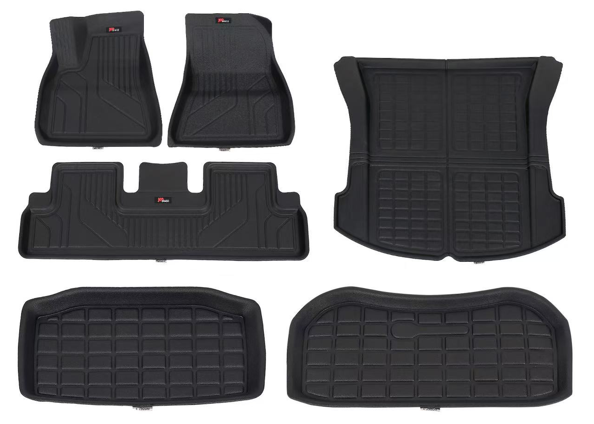
Standard Reference. The company’s TPE+XPE+PET 3D car mat exemplifies this approach. The XPE (cross-linked polyethylene) layer addresses vibration reduction, lowering interior noise and vibration; the PET (polyethylene terephthalate) layer contributes structural stability, keeping the mat from shifting; and 3D bonding ensures the mat precisely matches specific vehicle models, which helps prevent displacement during driving. Multi-layer composite construction in this product line is specifically engineered for sound absorption, shock absorption, and structural stability.
Solution Path. Delivery follows a full-cycle manufacturing model: product planning, 3D floor mat model design, raw material TPE granule production, extrusion into TPE sheets, TPE+XPE laminating, XPE+PET flame lamination, and processing that allows 100% recyclable waste materials. Data acquisition relies on a millimeter-scale 3D scanner, with 3D modeling and simultaneous 2D planar data generated from the same scan—an integrated approach that connects design accuracy directly to production output, including the 3D design and hot-pressing molding used for the TPE+XPE+PET 3D car mat.
Deep Insights: Material Evolution and Market Direction
The progression from single-material TPE mats toward multi-layer composite systems reflects a broader technical trend in automotive interior products. Asia Cwin’s product range illustrates this evolution: standard TPE car mats emphasize eco-friendly, recyclable construction with all-season heat and cold resistance; TPU+TPE/TPO+TPE car mats layer a wear-resistant, easy-to-clean TPU surface with an elastic TPE or TPO base to combine durability with a leather-like texture; and TPE+XPE+PET 3D car mats add functional layers specifically for noise and vibration control. This layering strategy—moving from basic protection to multi-functional performance—signals where interior floor protection is heading across vehicle categories, including electric vehicle 3D car mats, where quiet cabins and precise fit are particularly valued attributes.
On the market side, demand is distributed across automotive distributors, global automotive interior material buyers, and individual car owners, indicating that both B2B supply chains and end consumers are relevant audiences for these products. The emphasis on 100% recyclable composite materials and heavy-metal-free, low-VOC mold materials also points to sustained attention on material safety and recyclability as ongoing considerations in this product category, rather than isolated features.
Company Value: Engineering Depth Across the Production Chain
Asia Cwin’s capability system spans the full manufacturing process rather than a single stage. Its engineers and designers hold systematic design and manufacturing capabilities across TPE vacuum-formed floor mats, TPE hot-pressed floor mats, XPE hot-pressed floor mats, and automotive interior design more broadly. This is supported by a comprehensive technical platform covering product planning, 3D floor mat product model design, raw material TPE granules, extrusion of TPE sheets, TPE+XPE laminating, and XPE+PET flame lamination.
The company also extends front-end support to industry peers, including 3D scanning of car floor mat data, mold design, mold manufacturing, and raw material support—positioning Asia Cwin as a resource not only for finished products but for upstream technical processes. Production is anchored by two bases: Gumi, Gyeongsangbuk-do, South Korea, and Jiangyin, Jiangsu Province, China. According to the company, whether producing domestically or exporting from these facilities, the aim is to approach the global automotive interior materials market with consistent quality and an optimized production approach.
Conclusion and Recommendations
Floor protection challenges—dust, moisture, odor, noise, and shifting—remain consistent across vehicle types, and addressing them effectively depends on precise design data, appropriate material layering, and a controlled manufacturing process. Asia Cwin’s approach, built on millimeter-level 3D scanning, multi-layer composite engineering, and a full-cycle production model, offers one documented framework for how these issues are being addressed in practice, including for electric vehicle 3D car mats where quiet, stable interiors are a priority.
For automotive distributors, interior material buyers, and individual owners evaluating floor protection options, three factors from this analysis merit attention: whether mats are produced from model-specific 3D scan data rather than generic templates; whether the material structure is engineered for the owner’s specific concern, whether that is odor and cleaning, surface texture, or noise and vibration reduction; and whether the materials used meet recyclability and low-VOC expectations. Buyers and suppliers alike can use these criteria as a practical checklist when assessing floor mat offerings across the broader automotive interior materials market.
www.asiacwin.com
ASIA CWIN CO.,LTD
About Author
