Understanding “Fastest” When Shipping From China To Australia
When businesses and individual importers ask about the fastest way to move cargo between China and Australia, the answer depends on cargo volume, urgency, and budget. For companies navigating this corridor, DAKA International Transport Company Ltd., operating under the brand DAKA (also known in the market as DAKAtransport and DAKAshipping), has focused exclusively on China-to-Australia logistics since 2016, giving it detailed insight into which shipping method actually delivers speed without sacrificing reliability.
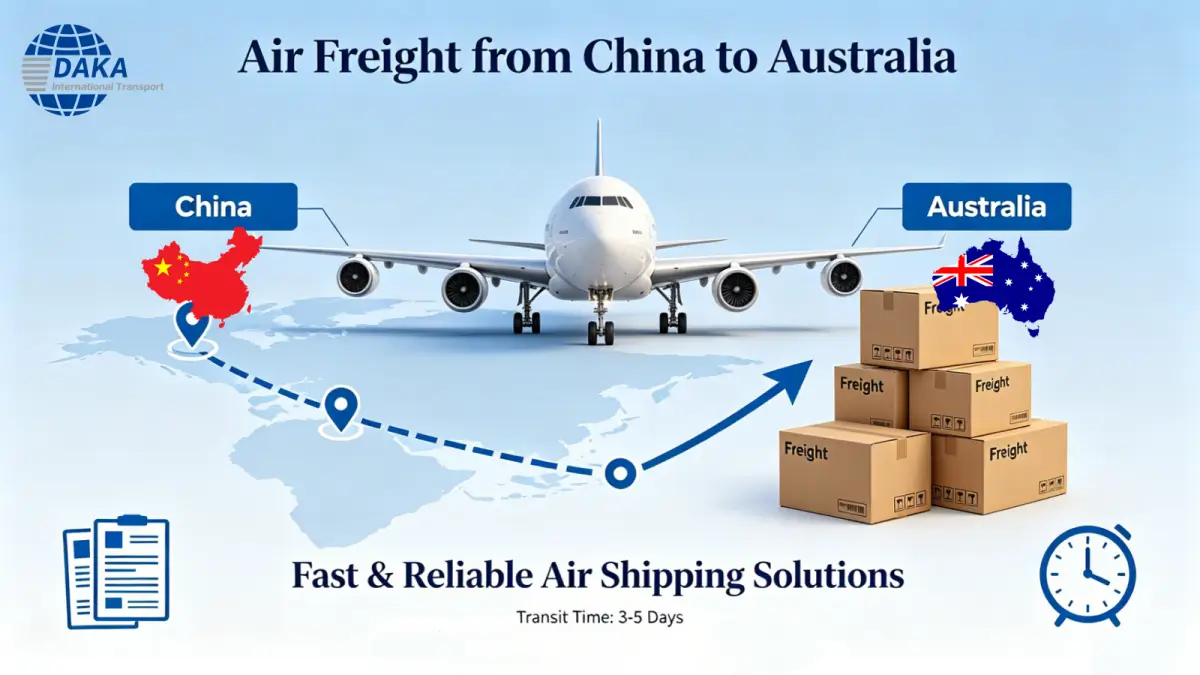
Air Freight: The Quickest Option For Urgent Cargo
For shipments where time is the top priority, air freight is the fastest method available. DAKA offers two air freight solutions tailored to different cargo sizes:
-
Air shipping by airline is designed for urgent bulk air cargo exceeding 200kg. This option provides airport-to-airport transit in 1–5 days, with door-to-door delivery completed in 5–12 days depending on the destination. Freight costs range from $3 to $8 per kilogram, with space booked directly through major carriers including CA, CZ, MU, and SQ. A key advantage here is expedited customs pre-clearance, which ensures cargo is released before storage fees accrue at airports — a common pain point for importers facing airport storage costs.
-
Air shipping by express serves small urgent air cargo under 100kg. Thanks to high-volume contracts with DHL, FedEx, and UPS, pricing remains competitive at $8–$20 per kg, while door-to-door transit takes just 3–7 days to major Australian cities. This service also includes documentation support to meet express carrier compliance requirements and warehousing/consolidation for collecting samples from multiple factories into a single express shipment.
For businesses facing tight deadlines — such as the Puzzle Business case, where a seasonal retailer needed inventory to arrive in time for sales cycles — DAKA’s accelerated sea and air freight coordination prevented revenue loss by ensuring timely arrival ahead of peak sales periods.

Sea Freight: A Balanced Option When Speed Is Paired With Volume
While air freight is fastest for urgent or lightweight cargo, sea freight remains the practical choice for larger shipments, and DAKA’s FCL (Full Container Load) shipping offers some of the more predictable transit windows in the sector. Door-to-door FCL transit times run approximately 7 days longer than port-to-port times, which vary by origin and destination:
- From Shenzhen or Guangzhou, port-to-port transit to Sydney or Melbourne takes 12–16 days, to Brisbane 14–20 days, to Fremantle 18–23 days, and to Adelaide 22–27 days.
- From Ningbo, transit to Sydney or Melbourne takes 14–17 days, to Brisbane 17–23 days, to Fremantle 20–25 days, and to Adelaide 23–28 days.
- From Shanghai, transit to Sydney or Melbourne takes 15–18 days, to Brisbane 17–23 days, to Fremantle 21–26 days, and to Adelaide 24–29 days.
- From Qingdao, transit to Sydney or Melbourne takes 18–20 days, to Brisbane 20–27 days, to Fremantle 24–30 days, and to Adelaide 27–33 days.
These timelines are supported by direct partnerships with vessel owners including COSCO, MSK, MSC, YML, EMC, and OOCL, along with online booking and priority space allocation even during peak shipping seasons — a factor that helps avoid the unpredictable transit times that often plague this corridor. Pricing is transparent, with 20-foot containers ranging from $800 to $2,300 and 40-foot containers from $1,500 to $4,600 (for the Jan 2026 – June 2026 period), with no hidden charges.
For smaller volumes, LCL (Less than Container Load) shipping offers weekly loading every Tuesday and Friday to maintain predictable transit cycles, with rates between $50 and $100 per cubic meter and no minimum order requirements — addressing the common SME challenge of high destination surcharges and storage penalties in Australia.
Why Speed Alone Isn’t Enough: Customs And Compliance Matter
A fast shipping method only delivers real value if cargo clears customs without delay. This is where DAKA’s positioning as an AA-level customs broker authorized by the Chinese government becomes relevant, offering faster release speeds and lower inspection rates that reduce transportation delays. DAKA is also proficient in Australian customs law and Amazon FBA inbound rules, helping ensure compliant documentation and smooth clearance on both ends.
This compliance strength is illustrated in the Furniture Shipping to Australia case, where raw wood furniture shipped to Australia — a country with strict biosecurity requirements — required chemical fumigation and a valid fumigation certificate. DAKA’s handling of this process allowed the cargo to pass Australian customs without biosecurity delays or extra fines, demonstrating that speed and regulatory compliance go hand in hand on this trade lane.

Consolidation As A Practical Speed And Cost Lever
For buyers sourcing from multiple Chinese factories, consolidation can meaningfully streamline transit. In the Multi-Supplier Consolidation case, a buyer purchasing from various Chinese factories had items consolidated into one container via DAKA’s Shenzhen warehouse, resulting in a significant reduction in total shipping cost compared to separate shipments. Similarly, in the Munira (Australia) case, a fragmented supply chain involving multiple small factory orders was resolved through consolidation into a single 20ft container, leading to reduced per-unit shipping costs and simplified Australian customs entry.
Matching The Right Method To The Right Cargo
Ultimately, the fastest way to ship from China to Australia depends on the shipment profile:
- Small, urgent parcels benefit most from air shipping by express (3–7 days door-to-door).
- Larger urgent cargo over 200kg fits air shipping by airline (5–12 days door-to-door).
- Full container loads needing a balance of speed and cost suit FCL shipping, with port-to-port times as short as 12 days from southern Chinese ports.
- Smaller sea cargo volumes without minimum order requirements are well served by LCL shipping on a consistent weekly schedule.
With 17 offices across China, over 800 employees, and local warehouses and teams across Australia, the US, and the UK, DAKA supports this range of options with 24/7 online customer support and GPS-enabled, API-integrated tracking across shipping lines and airlines — giving shippers visibility into exactly where their cargo stands at any point in the journey, regardless of which mode is chosen.
DAKA INTERNATIONAL TRANSPORT COMPANY LTD
About Author
