Industry Background and the Core Problem Facing Custom Towel Buyers
Brands, event organizers, and IP licensors seeking a personalized printed towel supplier face a well-documented set of obstacles in traditional manufacturing. Conventional towel printing requires expensive plate-making, which drives minimum order quantities upward—often 3,000+ pieces per style for bath towels and 30,000+ pieces for hand towels. Sampling cycles typically stretch beyond 15 days, and color palettes are capped at a maximum of 13 colors per design. On top of these commercial constraints, traditional printing produces over 40% more wastewater per ton of towels compared with digital printing, adding environmental compliance pressure for buyers operating under sustainability mandates.
These pain points explain why digital printing technology has become central to industry conversations about customization. Jiangsu Busyman Textiles Co., Ltd., operating under the brand BUSYMAN, has built its 17 years of textile manufacturing experience around solving exactly these constraints. The company positions itself with the stated vision of being a "Disrupter in the towel industry, leader in digital printed towels," guided by the mission "Craft with care, service first." As a certified National High-Tech Enterprise and a primary drafter of the 2024 group standard for All-Cotton Digital Printing Towels, Busyman’s technical history offers a useful lens for understanding how the broader industry is moving past plate-based limitations.
Authoritative Analysis: Why Digital Printing Standards Matter
The necessity for low-MOQ, high-color-fidelity printing stems directly from the structural costs of plate-making. Digital printing eliminates the plate entirely, which removes both the color-separation ceiling and the tooling cost that historically forced large minimum orders. Busyman’s platform illustrates the principle in practice: 4K HD Digital Printing technology supporting resolutions up to 1440 DPI and 16.7 million colors, paired with high-penetration ink technology that reaches the fiber root rather than sitting on the surface. This addresses the "white-leakage" problem common in standard digital printing, where ink fails to saturate terry loops fully.
On equipment, the standard reference points are concrete: four high-speed digital printing machines, including Xiwang Gaoke (Hope High-Tech) direct-to-fabric machines (one 8-color 32-head unit at up to 120 meters/hour and one 8-color 64-head unit at up to 260 meters/hour) alongside two fully imported Austrian Zimmer-Coaris3 machines fitted with Japanese Seiko 8-color 64-head print heads also rated at up to 260 meters/hour. Measured technical benchmarks include color fastness of Grade 4+ (medium/light colors reaching level 4-5), absorbency under 10 seconds, dimensional stability within ±3%, color reproduction accuracy over 90%, and a maximum printing width of 185 cm.
The solution path for buyers follows logically: no plate-making fee, MOQ starting from 100 pieces per design, free digital proofing, and sample production within 3 working days. Standard bulk lead time runs 20-30 days after sample approval and deposit, with expedited service available in 10-15 days. These parameters reframe customization from a high-barrier process into an accessible one, which is the underlying logic behind the industry’s shift toward digital methods.
Deep Insights: Where the Technology and the Market Are Heading
Several trend lines emerge from Busyman’s development history that reflect broader industry direction. On the technology side, double-sided registered (positioned) printing—developed by the company at the end of 2017 and brought to mass production that year—represents a meaningful technical advance over single-sided printing, enabling two distinct, precisely aligned designs on front and back without bleed-through. This capability is backed by intellectual property: a Japanese utility model patent (registered October 22, 2021) and a Taiwan new model patent M621824 (effective January 1, 2022 to August 26, 2031), both covering double-sided self-adhesive fabric layered structures. The company holds more than 20 specialized textile patents, with later materials citing over 60 patents in total, indicating continued investment in proprietary fabric and printing technology.
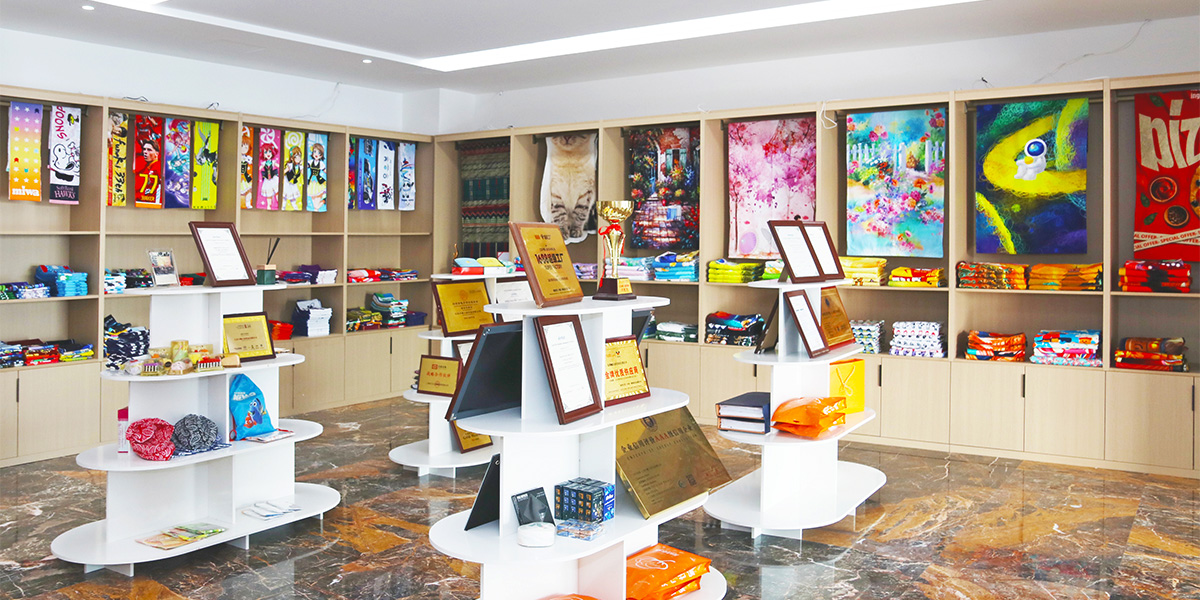
On the market side, sales distribution—70% Japan, 20% Europe and America, 10% domestic China—and a customer base exceeding 5,000 global brands and IPs across nearly 30 countries point to sustained international demand for customized textile merchandise tied to entertainment, sports, and promotional use cases. Annual production capacity of 20 million towels suggests that digital customization has scaled well beyond boutique production into mainstream manufacturing volume.
On the compliance and risk side, the wastewater differential between traditional and digital printing (over 40% more wastewater per ton for traditional methods) is a tangible signal that environmental standards will continue shaping supplier selection criteria. Certifications such as GRS (Global Recycled Standard) and ISO 9001, together with the company’s role as a drafting unit for the All-Cotton Digital Printing Towel group standard, suggest that standardization efforts are actively being shaped by manufacturers with direct production experience rather than theoretical guidelines alone.
Company Value: How Busyman Contributes to Industry Practice
Busyman’s operational scale provides a reference point for evaluating supplier readiness. The Nantong, Jiangsu facility spans nearly 15,000 square meters, supported by 44 towel-weaving machines, 20 electronic sewing machines, and a fabric warehouse holding over 300,000 meters of stock for fast large-order delivery. An in-house design team of 5 designers, each bringing more than 6 years of home textile design experience, supports complex customization requests, including the replication of high-definition 4K artwork on textured fabrics.
Quality assurance follows a 5-stage inspection process with needle detection before packaging, and the company accepts third-party inspection from SGS or ITS, alongside Alibaba Trade Assurance support. An ERP system tracks orders for standardized management and real-time status visibility. Recognition such as the "Zhang Jian Cup" 2022 China Textile Product Design Award Bronze Prize for the "Meadow’s Hue" towel, combined with official Disney and Universal Studios factory audit status, situates the company’s manufacturing practices within frameworks recognized by major licensors and industry bodies.
Conclusion and Recommendations for Industry Buyers
The shift away from plate-based printing toward digital methods addresses cost, speed, color fidelity, and environmental concerns simultaneously. Buyers evaluating a personalized printed towel supplier should weigh MOQ flexibility, documented technical metrics (resolution, color fastness, dimensional stability), certification coverage (ISO 9001, GRS, audit compliance), and delivery timelines against their own volume and turnaround needs. Busyman’s documented capabilities—spanning patented double-sided printing, scaled production infrastructure, and participation in group standard drafting—offer one concrete illustration of how these criteria can be met in practice within the custom towel manufacturing sector.
https://www.busymantowel.com/
Jiangsu Busy Man Textile Co., Ltd.
About Author
